

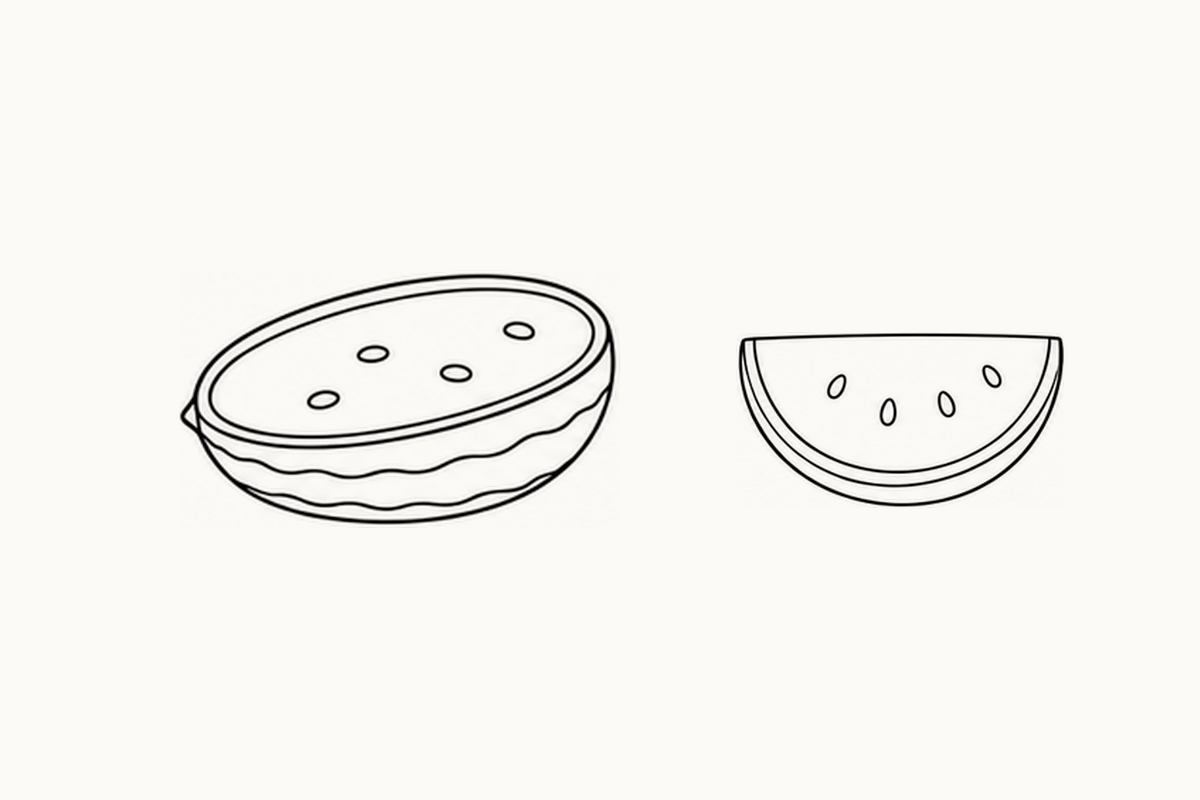
These elementary watermelon coloring pages offer five A4 sheets of halves, quarters and slices, with two empty drawing bands on every page. Set out page 1, a pencil and a few colors. Find the semicircular slice in the second position of the lower row and ask, “Which curve separates the flesh from the rind?” Your child can point to that narrow band, color a cut face or draw a larger semicircle below. The printed portions provide the views for this paper activity; you do not need to prepare or cut real fruit.
Download the five-page Elementary Watermelon PDF (1.44 MB)
A cut face is different from the outside wall
Each sheet has eight reference arrangements. The first eight selected source positions recur in five orders, giving forty printed positions rather than forty unique drawings. Some arrangements contain more than one portion: there are two complementary halves together and a whole melon beside a thick slice. Several faces are plain, while some show a few hollow seed shapes. The source does not give every piece a fixed seed count. Broad open bands remain on the curved outside, and a thin boundary separates flesh from rind.
Choose the simple semicircular face
Point to the straight edge across the top of the semicircular slice, then follow the large curve beneath it. A second curve nearby makes the thin rind band. Compare that with the oval-faced half at the upper left, whose outside wall curves underneath the open face. Your child can choose which outline to color first. For the drawing activity below, the front-facing semicircle keeps the face and rind easy to separate without needing to show a complicated angle.
See all five complete sheets
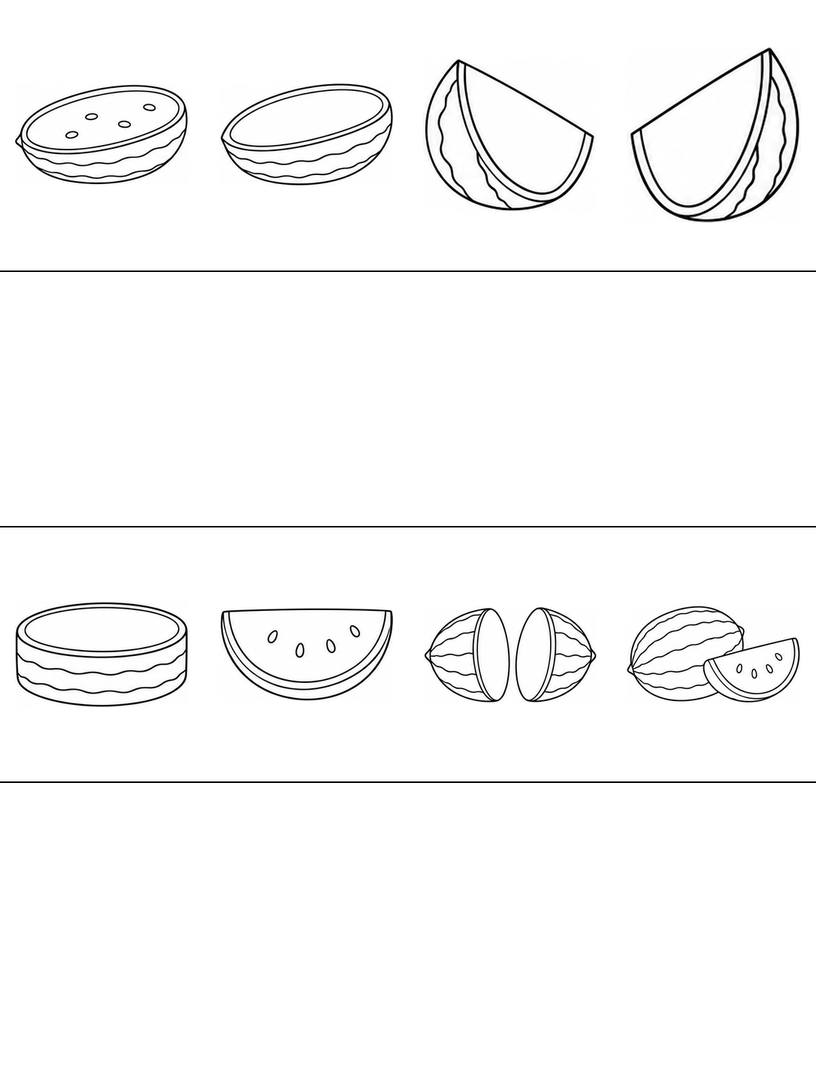
Page 1 puts oval-faced halves and quarters across the upper row. One half has hollow seeds and the other has a plain face. The lower row adds a blunt middle slice, the semicircular slice, paired halves and a whole melon with a separate slice. Ask your child to find one plain cut face before choosing whether to add any seed shapes in their own drawing.
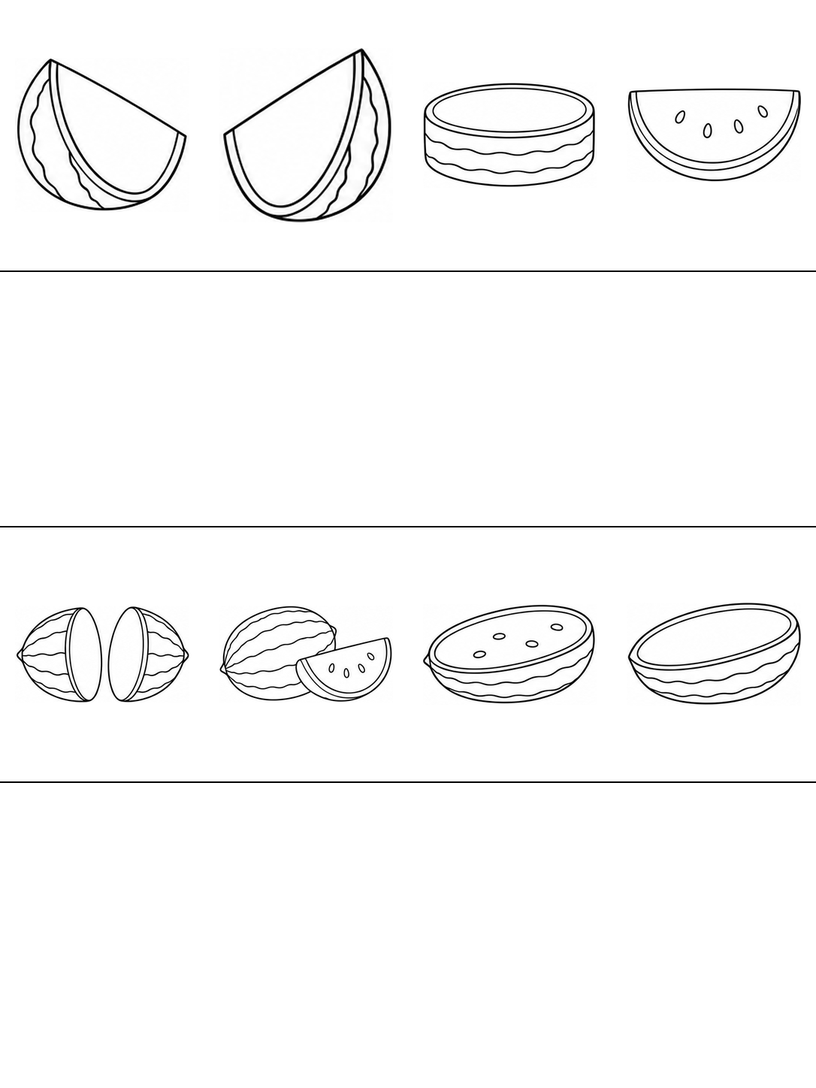
On page 2, the quarters start the upper row and the semicircular slice sits at its right end. Their cut faces have different outside shapes, but both meet a narrow rind edge. Below, the paired halves remain separate pieces. They do not need a line between them or a new stalk to make them belong to the same drawing activity.
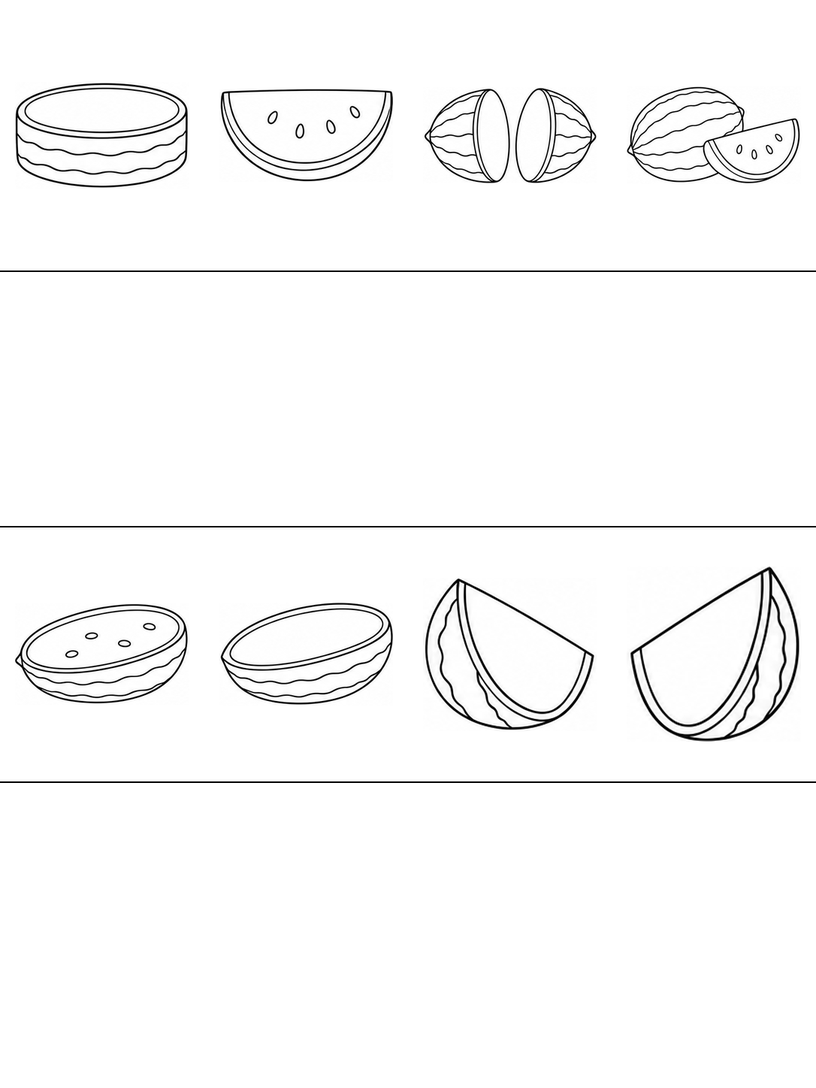
Page 3 begins with the blunt middle slice. Its open face is an oval above a banded outside wall. Compare that complete ring-like edge with the straight top and curved bottom of the neighboring semicircular piece. You can say, “Which outside shape shall we try?” There is no need to draw every portion on the page or to give all of them seeds.
On page 4, the paired halves move to the upper left. Each pale face belongs to its own curved rind shell. In the neighboring group, a whole fruit sits beside a smaller slice. Point to the boundary of the slice rather than continuing its line across the whole melon. The arrangement contains two pieces, even when their outlines are close together.
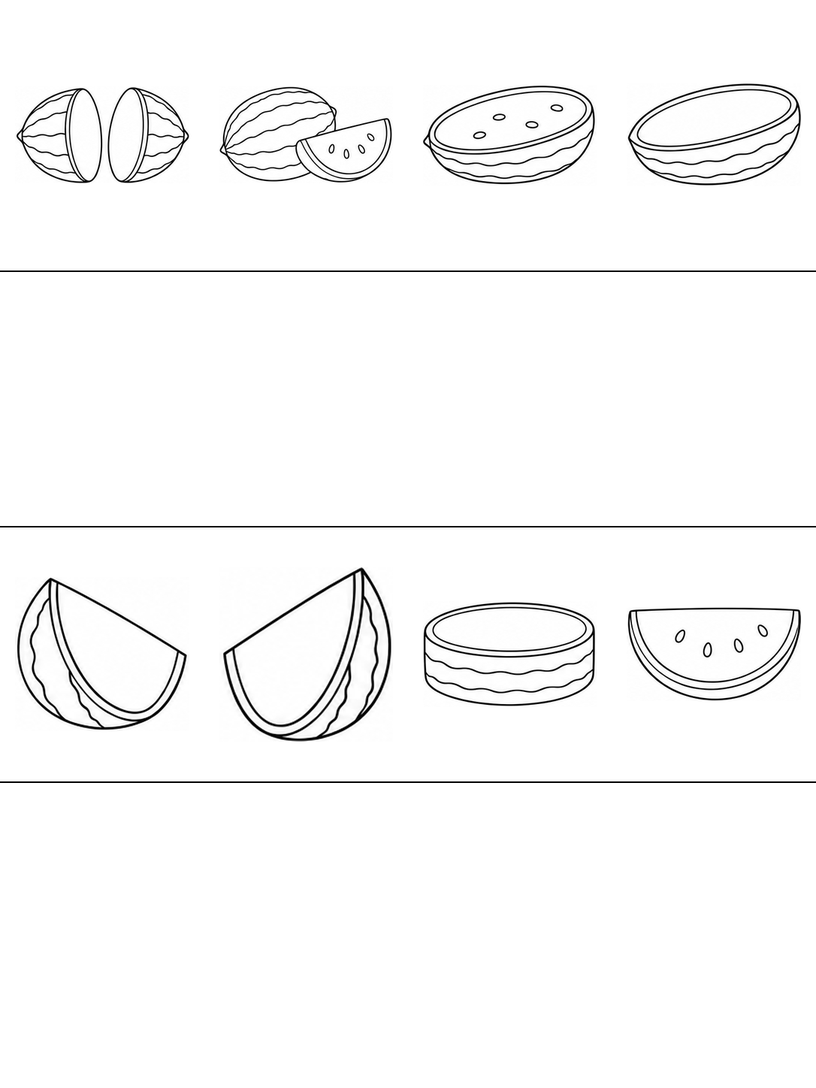
Page 5 starts with the plain oval-faced half, while the semicircular slice returns at the lower left. Choose the plain half if you want open coloring space, or revisit the semicircle for a second drawing. Keeping a familiar shape lets you change one choice, such as the rind color, without beginning a whole new collection of details.
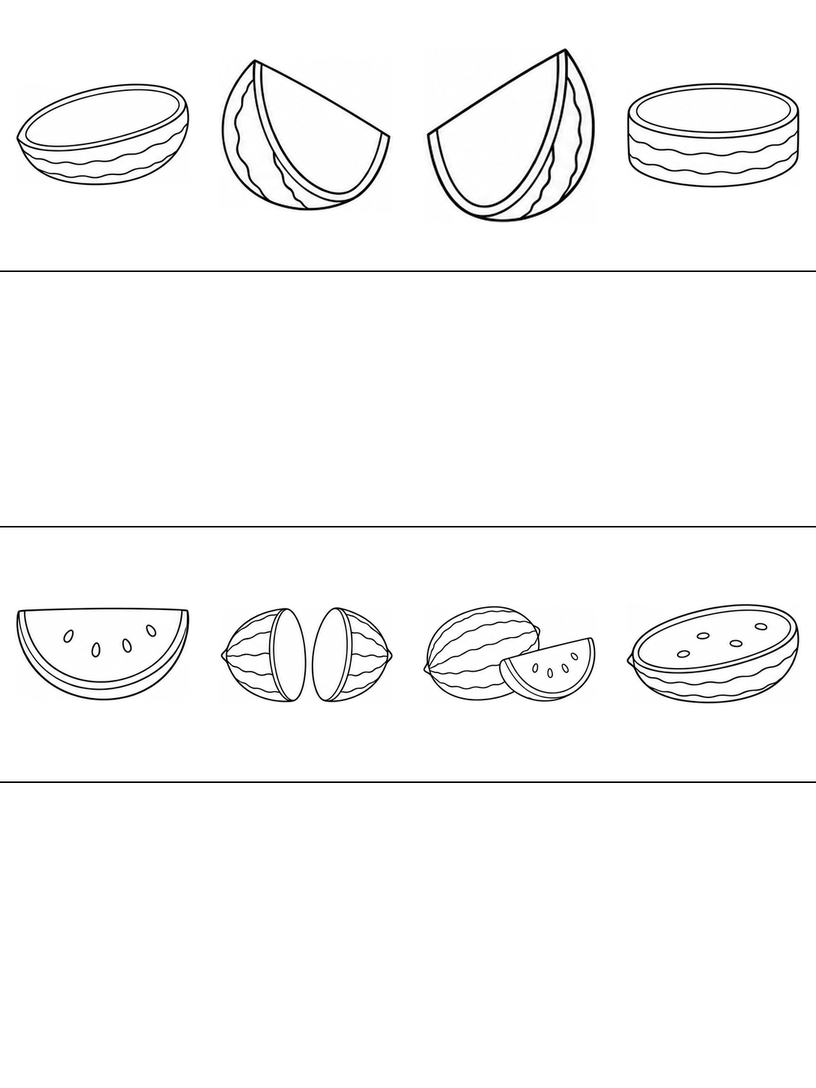
Draw one semicircular slice with a clear rind
Use the lower-row semicircle on page 1 as your reference. Start in a blank band or on another piece of paper. Leave room below the straight top for a broad flesh area and a narrow curved rind, rather than squeezing both into a tiny space.
- Join a straight top to a broad curve. Draw one light line for the top cut edge. From its ends, draw a smooth lower curve to make a semicircular face. Keep the two corners connected; the shape can be uneven and still be a useful starting point.
- Add a nearby curve for the rind. Draw another curve just inside the rounded lower edge, bringing it back to the top corners. Leave a narrow band between the curves. This follows the rind around the slice without dividing the whole flesh area into many thin rings.
- Choose open seed shapes or a plain face. Place a few small oval seed outlines inside the broad flesh area if you want them. Keep them away from the rind boundary and leave their centers open. You can also leave the face plain, then choose different colors for flesh and rind.
If the rind takes over the face, bring its inside curve nearer the outside edge on your next drawing. If the slice looks like a shallow bowl, keep the flesh as one open area rather than adding more inner rings. If the seeds crowd the edge, use fewer or omit them. Ask, “Which space is the flesh, and which narrow space is the rind?” Pointing to those two areas can be the whole activity if drawing another shape feels like too much.
An optional made-up paper picnic
Imagine a pretend paper picnic where one drawn slice marks a place for a visitor. Ask your child to choose a slice on the worksheet, then draw their own larger semicircular piece in a blank band. They can add a small place card beside it and choose a color to match. The visitor, picnic and place card are made-up additions; the PDF contains fruit references and empty bands, not a finished picnic scene or food-preparation instructions.
Return to one whole-fruit outline if you like
The Beginner apple sheets offer a single whole body and stem if the cut pieces feel busy. The Beginner bird sheets provide a different outline with a beak and tail. You can also stay with a plain watermelon face and color only that shape; moving to another subject is optional.
Printing and file notes
The download contains only the five Elementary watermelon sheets, not every level in the source workbook. Choose A4 paper and 100% / Actual size in your PDF reader. Inspect the preview for missing borders, then try one page before printing the rest. Use Fit if your printer needs more margin. The printing guide explains these choices. The files have been checked digitally; no physical print test has been performed, and the result on your printer has not been verified.
Worksheet questions
Does every cut face have four seeds?
No. Several references have plain simplified flesh, and visible hollow seed counts vary between other pieces. Use the actual drawing rather than adding a fixed number to every face. A plain face is also an option for your own slice.
Are the two complementary halves one connected object?
No. The paired reference shows two separate halves beside one another. Each face belongs to its own curved outer shell. Keep the pieces separate if you choose that arrangement, and avoid joining their flesh areas with an extra line.
Does this download include the whole multi-level workbook?
No. It contains only five Elementary sheets, with eight reused arrangements and two empty bands on each page. The forty positions are not forty unique designs. Choose a layout you like rather than printing every level or completing every page.
Use and sharing
You may print these pages for personal, family or classroom activities. Keep the website credit on the sheets. Share this article link with other adults instead of redistributing or selling the PDF. Read the terms of use for the permission and its limits.
Creation and editorial note
The activity guide and page layout were prepared and edited for Coloring Pages Story, with AI assistance. The line art is AI-assisted. The page previews and five-page PDF have been checked digitally. No classroom trial or physical print test has been performed.
Comments
Comments are closed