

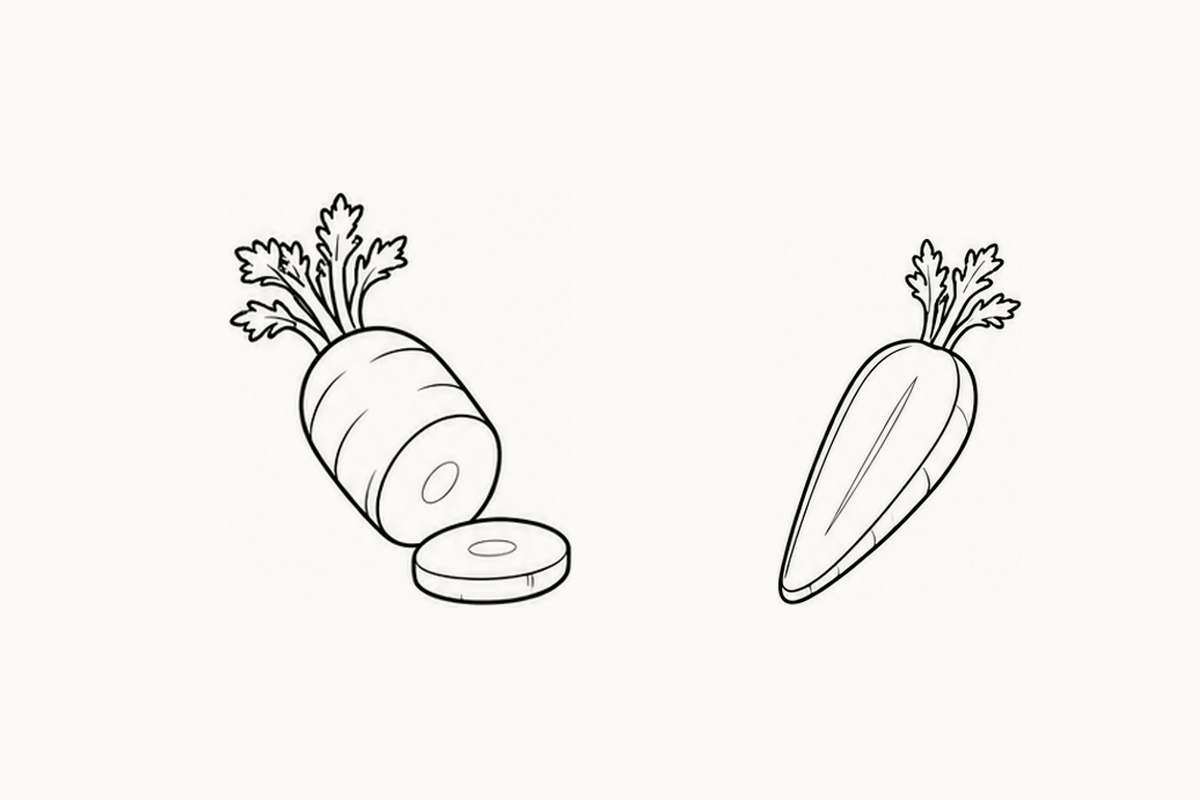
These elementary carrot coloring pages contain five A4 sheets of cut and partly peeled root studies. Start with page 1 and a pencil, then find the upper-left carrot with a flat cut end and a small round slice beside it. Ask, “Which piece still has its leafy top?” Your child can color one open flesh area, trace the root wall or draw a simpler cut root below. Work only from the pictures; this is a paper drawing exercise and does not call for cutting or peeling real food.
Download the five-page Elementary Carrot PDF (2.18 MB; 2,178,498 bytes)
Compare the cut face with the outside wall
Each sheet has eight reference arrangements and two blank drawing bands. Six main cut or peel tasks recur with opposite-view alternatives across the five combinations. Forty printed positions are not forty independent designs. The set includes a cross-cut root beside a slice, a lengthwise half, a quarter, attached peel, a blunt middle segment and paired long halves. A cut face is a surface closing part of a solid root, not a hole through it. Leave the simplified flesh areas open while you work out where a face joins the curved outside.
Find one round face and its matching root
Look at the first reference on page 1. The broad end has attached leaves, while the nearer flat face shows a small core outline. The separate thin slice sits beside the same study. Point around the face edge and then along the root wall behind it. Say, “This outline closes the end; that curve goes back toward the leaves.” Your child can use different colors for face and wall before trying a new outline. A neat core ring is optional; the connected outside matters more than its exact position.
See all five complete sheets
Page 1 places the cross-cut root and slice, long half, quarter and attached peel above a blunt middle section, paired long halves and opposite quarter and peel views. Choose the first reference if you want one clear cut face connected to a leafy root body.
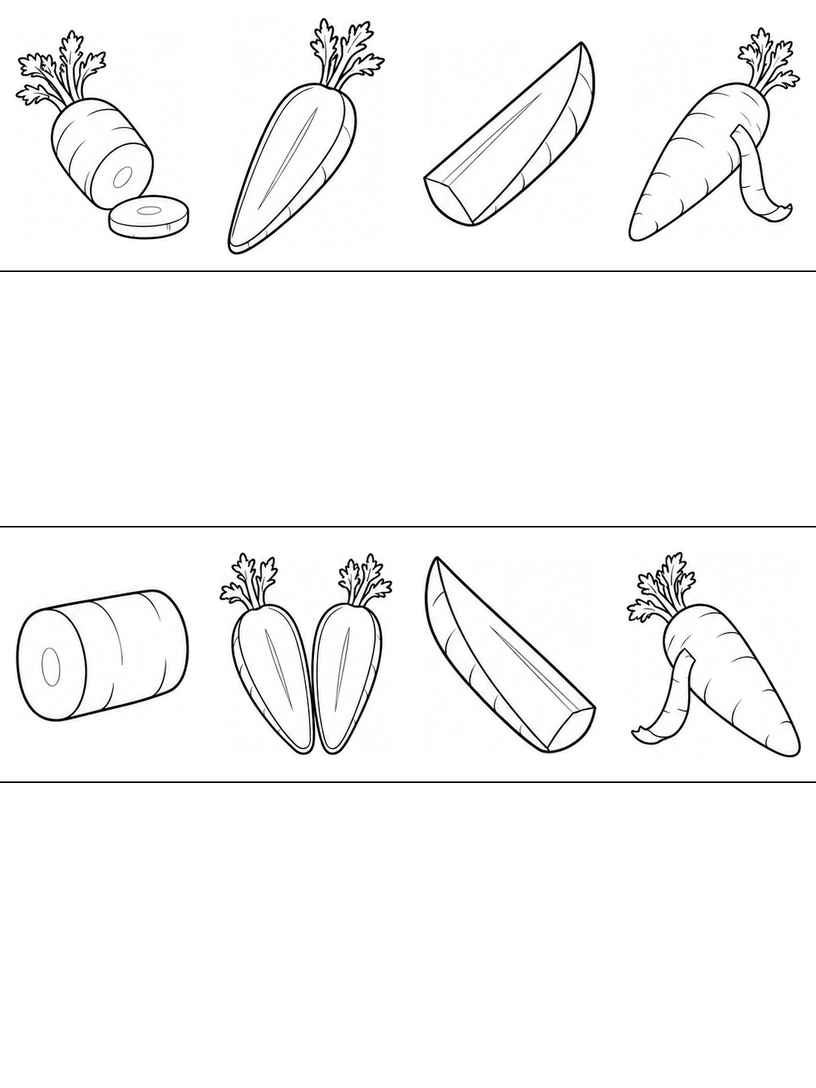
Page 2 retains the cross-cut root and long half, then changes the quarter and peel viewpoints. The middle section also turns the opposite way below. Notice how a different viewing direction changes the face outline while the surface still belongs to one solid piece.
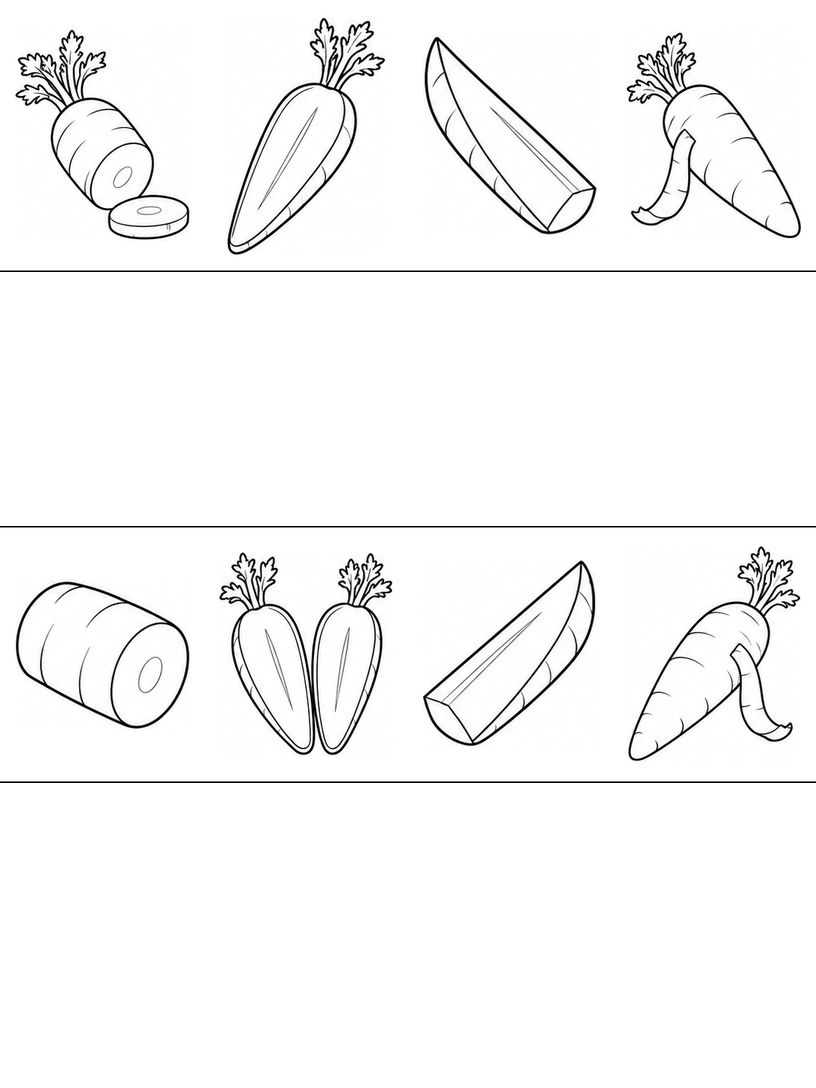
Page 3 returns to the first quarter orientation and mixes it with an opposite peel and middle-section view. Paired long halves remain separate roots rather than one double-faced object. Choose just one half to color, following its flesh plane back to its own attached leaves.
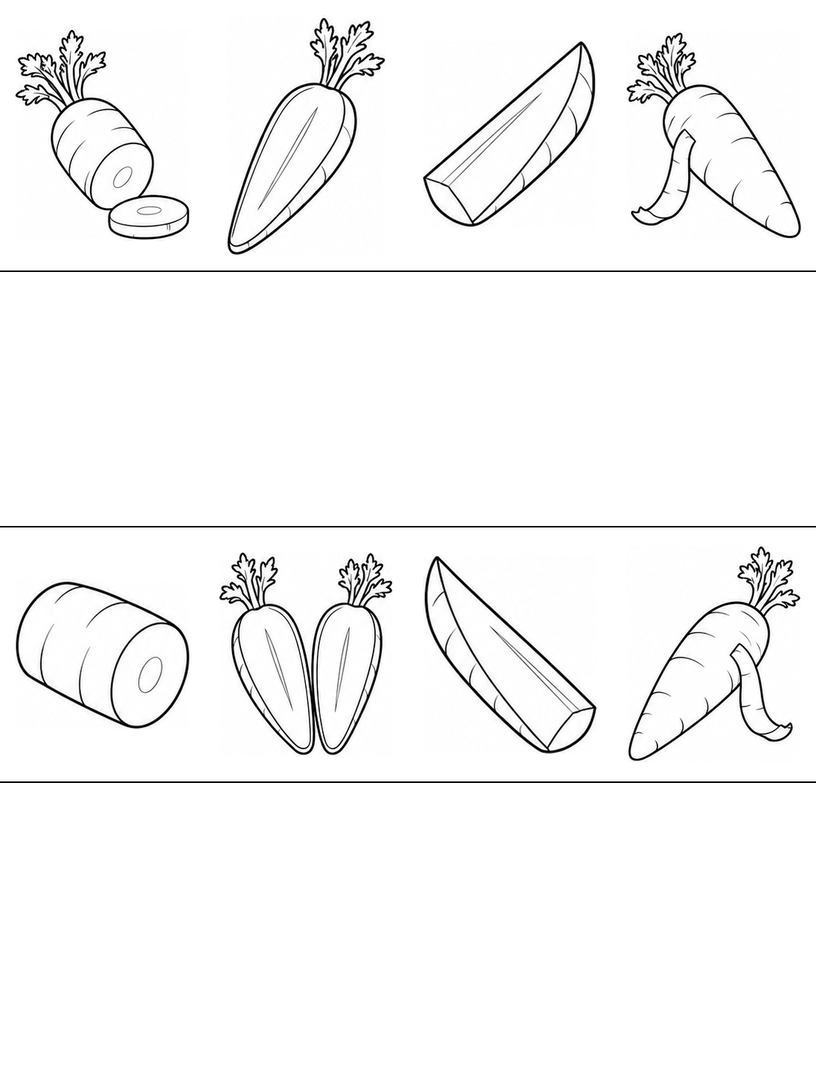
Page 4 combines the opposite quarter with the first peel view above the middle segment and paired halves. The extra quarter and peel studies below offer another direction to compare. Find where the peel strip remains attached; it should not become an unrelated ribbon beside the root.
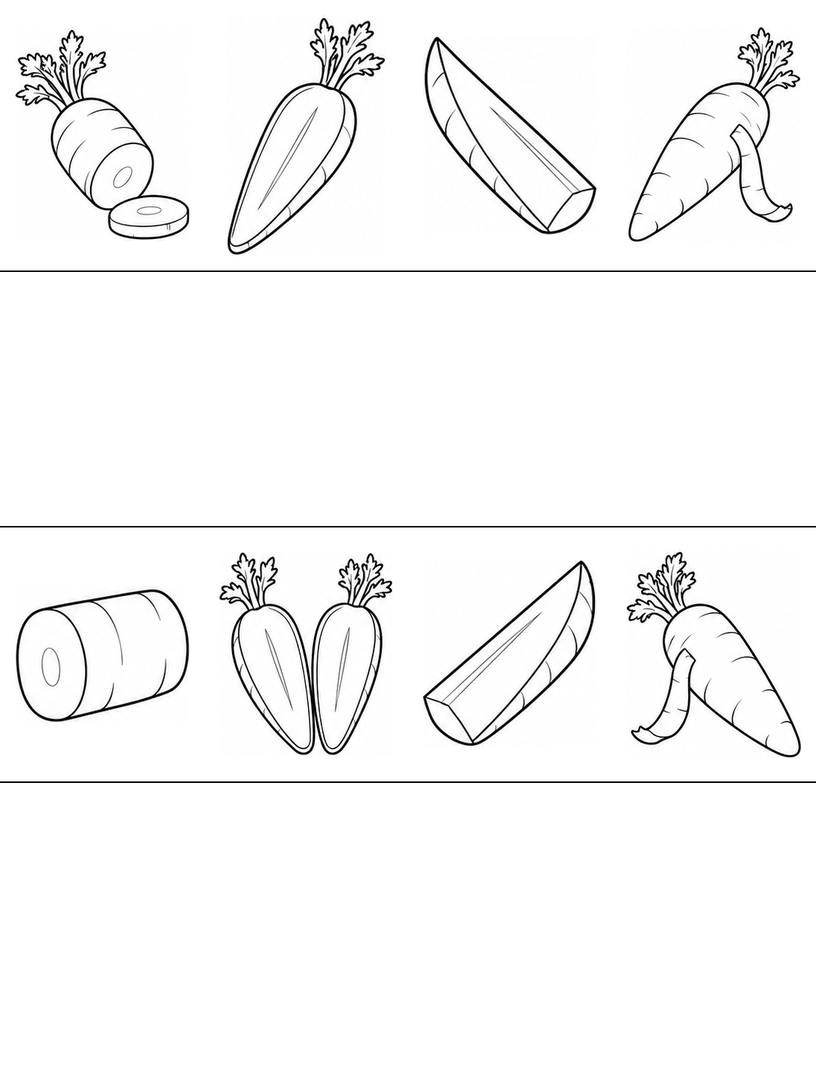
Page 5 revisits the familiar first cross-cut study and long half, with an opposite middle-section view below. You can use this page for a second attempt at one slice rather than repeating every reference. Keep a blunt two-ended segment distinct from a whole carrot with a natural pointed tip.
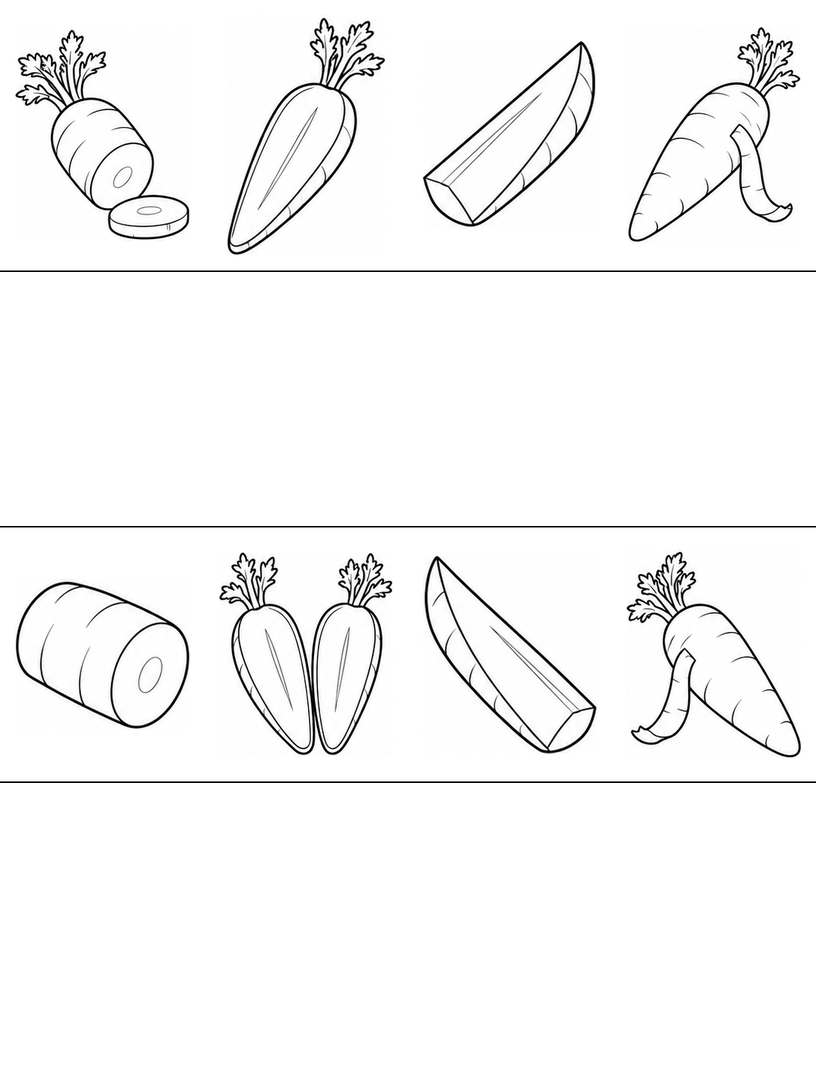
Draw a leafy root with a flat cut end
Use the first reference on page 1 as a guide for a larger, simpler drawing. Leave space behind the near face for the root and above its far shoulder for leaves. You can omit the separate slice on the first attempt, then add it beside the root if your child wants another shape.
- Begin with the near face. Draw an oval for the cut end, tilted as much or as little as you choose. Leave its middle open. This face establishes the width of the cut root, so use a size that leaves enough room for a simple body behind it.
- Join the face to the leafy shoulder. From the oval sides, carry two outer curves backward to a rounded shoulder. Attach a few stems and simple leaves there. The curved wall and flat face should meet at the same boundary; avoid placing a second unrelated carrot behind the oval.
- Add a core and an optional slice. Place a small core outline inside the face if you want it. Beside the root, draw a second flatter oval with a short lower edge for slice thickness. Keep the slice separate and supported, then add only a few root-wall marks before choosing colors.
If the cut face looks like a bowl opening, keep the flesh plain and bring the outer root wall back to the face boundary. If a peel study looks like a loose ribbon, trace its starting point at the root surface before drawing the curled end. A long half needs its own curved outside edge beneath the flat plane, while a quarter has two planes meeting along one edge. Ask, “Which outside curve belongs to this face?” Simplify to one face and one wall if the paired pieces become crowded.
An optional pretend shape display
Imagine a paper display with one card for a round slice and another for a long half. Your child can draw a small invented label in an empty band, then point to the matching shape on the sheet. The label might say a made-up name or show a simple symbol instead of words. These display cards and labels are your own additions, not printed scenes on the worksheets. The activity can stay as coloring or shape matching; it does not need to become a real food-preparation demonstration.
Choose another simple whole-subject outline
The Beginner apple sheets offer a rounded whole-fruit body and stem for another short turn. The Beginner bird sheets offer a body, beak and tail instead. You can also stay with this page and color only one reference. Choosing a different subject is optional; the level name describes the pictured tasks, not a tested age requirement.
Printing and file notes
The download contains only the five Elementary carrot sheets, not every level in the source workbook. Choose A4 paper and 100% / Actual size in your PDF reader. Inspect the preview for missing borders, then try one page before printing the rest. Use Fit if your printer needs more margin. The printing guide explains these choices. The files have been checked digitally; no physical print test has been performed, and the result on your printer has not been verified.
Worksheet questions
Does the peel strip float beside the carrot?
No. The peel studies retain a short strip attached to the root surface. Follow the strip back to that attachment before drawing its curled end. The empty band is a place to simplify the form, not a reason to turn it into a separate ribbon or add a cutting tool.
Is the middle section a whole pointed root?
No. The middle segment has blunt cut ends joined by a continuous outer wall. A whole carrot narrows naturally toward its tip, but that shape is different from the segment shown here. Comparing the two can help your child choose which edge needs to close a cut surface.
Are all five sheets needed for one activity?
No. Each page repeats familiar cut and peel tasks in a slightly different combination. Print one layout first and choose one reference. The download contains five Elementary sheets only, so it is not the complete multi-level workbook or a set of forty unrelated illustrations.
Use and sharing
You may print these pages for personal, family or classroom activities. Keep the website credit on the sheets. Share this article link with other adults instead of redistributing or selling the PDF. Read the terms of use for the permission and its limits.
Creation and editorial note
The activity guide and page layout were prepared and edited for Coloring Pages Story, with AI assistance. The line art is AI-assisted. The page previews and five-page PDF have been checked digitally. No classroom trial or physical print test has been performed.
Comments
Comments are closed