

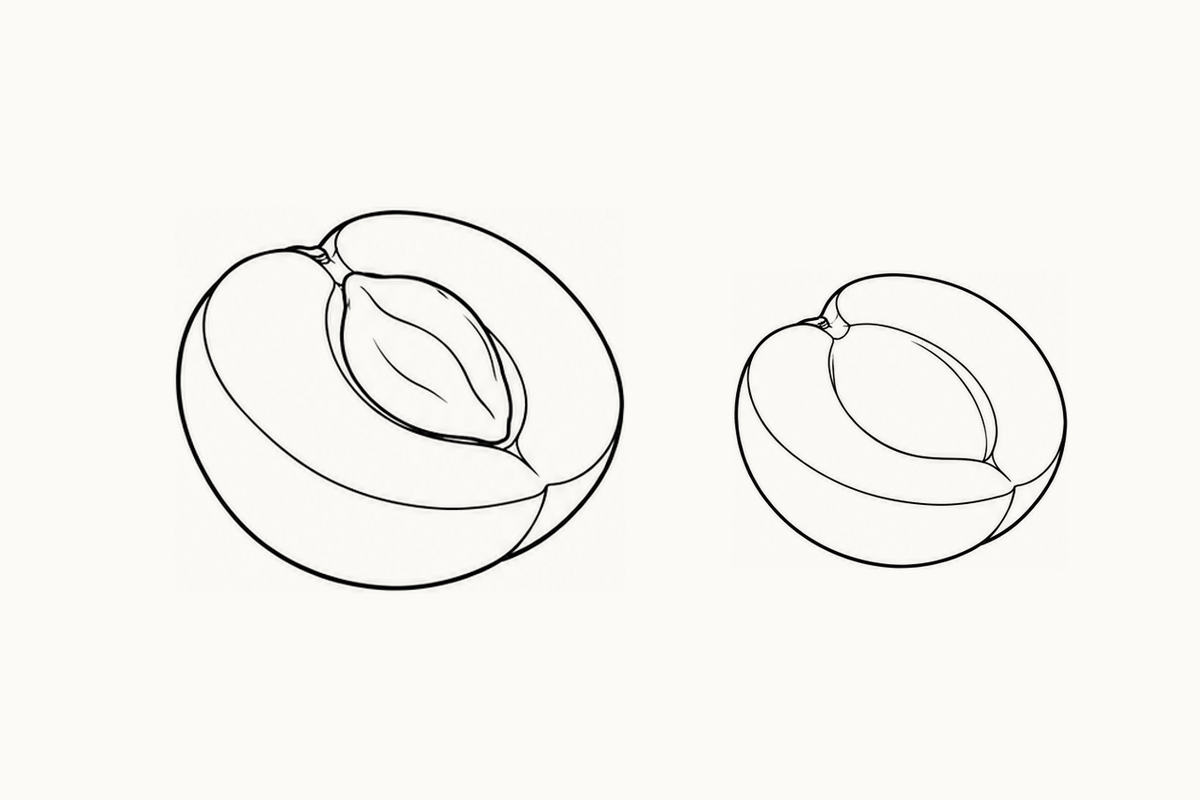
These intermediate peach coloring pages offer five A4 sheets of tilted halves, quarters and a partly peeled fruit, with blank bands for drawing. Put out one sheet, a pencil and a few crayons. Compare the first two halves on page 1 and ask, “Which one keeps the pit, and which has an empty hollow?” Your child can point, color one broad flesh area or draw a larger half below. Start with the cut face and its curved outside before copying the small lines on the pit.
Download the five-page Intermediate Peach PDF (1.75 MB)
Seven source tasks across five sheets
Each complete page contains four larger reference arrangements in two rows and two empty practice bands. The five layouts reuse seven selected complete source tasks; twenty positions are not twenty unique designs. Tilted halves show one pit or an empty cavity, quarters retain part of that cavity shape, and a short skin flap remains attached to a partly peeled whole peach. Complementary halves appear together with one pit total and an empty hollow in the companion half. The references use open white areas and only sparse pit grooves, without fuzzy skin texture or scattered tiny seeds.
Leave flesh around the center
Choose the pit half at the top left of page 1. Follow the open-face boundary, then the longer pointed shape of the pit within it. Notice the clear flesh space between that shape and the cut edge. Compare it with the neighboring half, whose center is an empty hollow. You can say, “This one still has its pit; that space is where the other half fitted around it.” Let your child choose either center. One clear boundary is enough to explore before adding grooves or a second half.
Look through the five complete sheets
Page 1 places a pit half beside an empty-cavity half. Below are a quarter and the partly peeled whole fruit. On the whole fruit, a shallow seam follows the rounded body and a short skin flap curls from an attached edge. The flap is an optional drawing subject, not something every half needs.
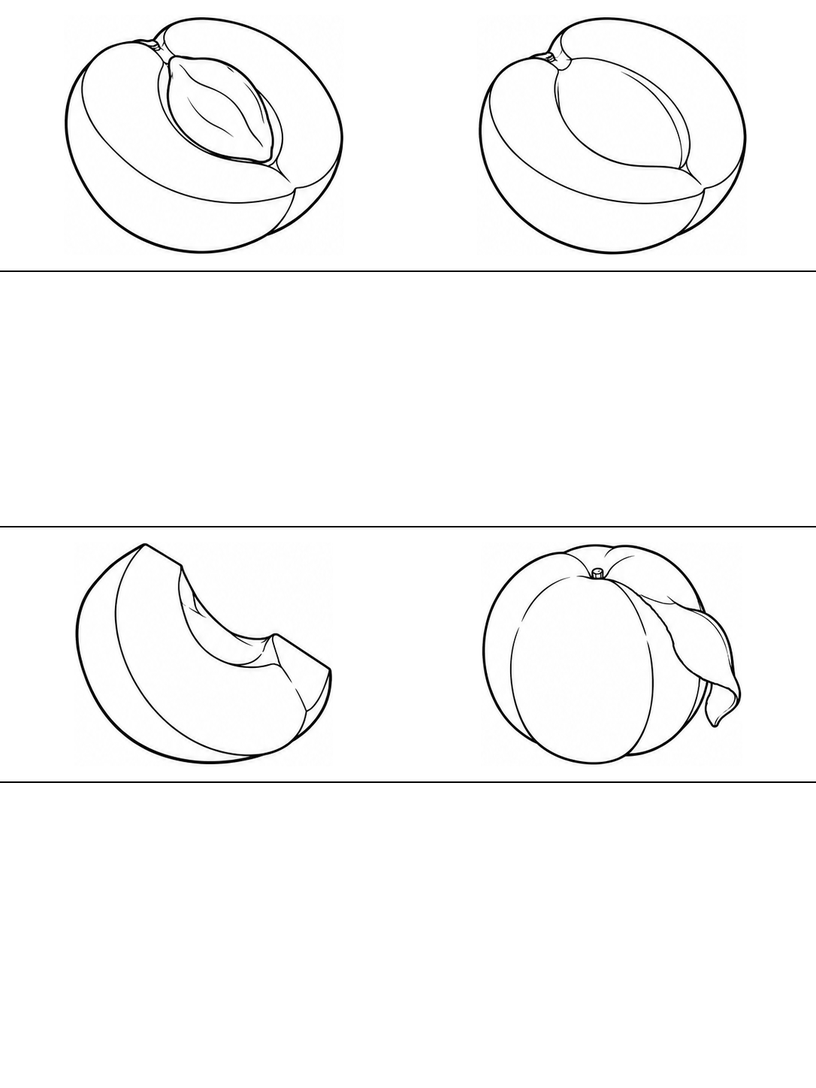
Page 2 offers the complementary pair and a thick quarter above a low oblique empty half and the peeled fruit. Find the single pit in the pair, then point to its companion cavity. Do not add another pit just because two flesh faces are visible.
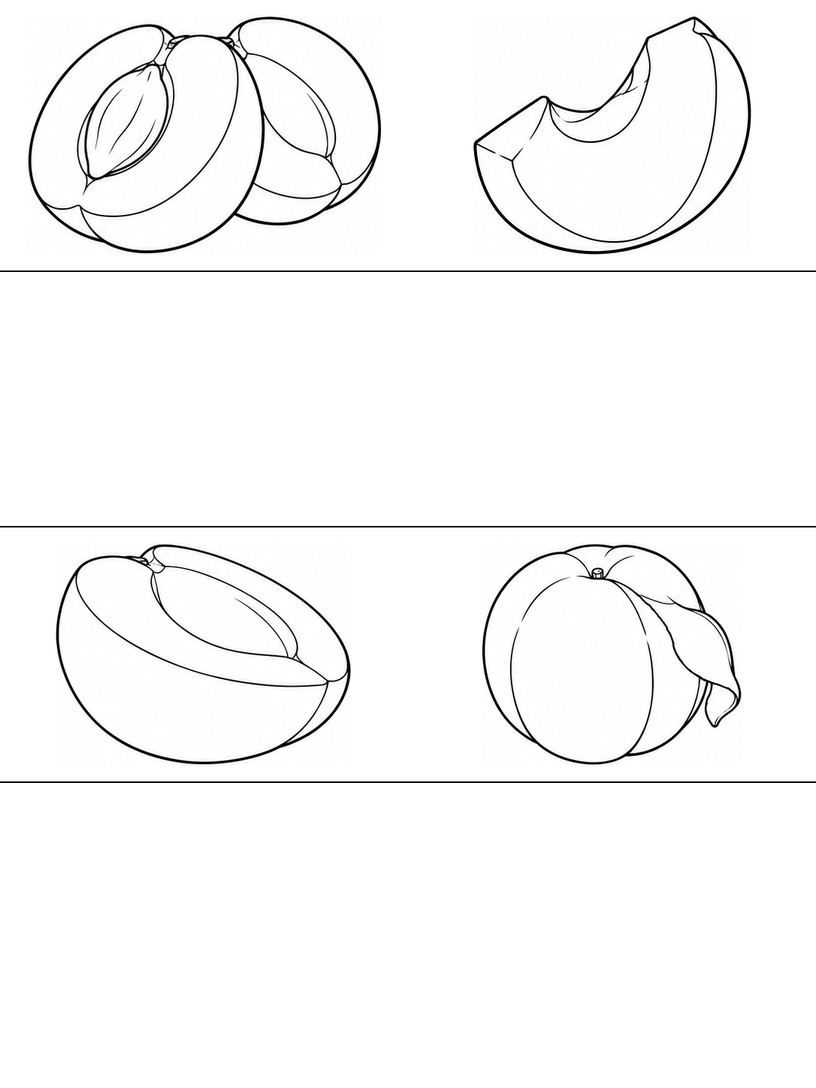
Page 3 combines a pit half and a quarter above the complementary pair and low oblique half. Follow the curved outside beneath one cut face. That wall gives the piece thickness; it joins the cut edge rather than sitting below it as a separate bowl.
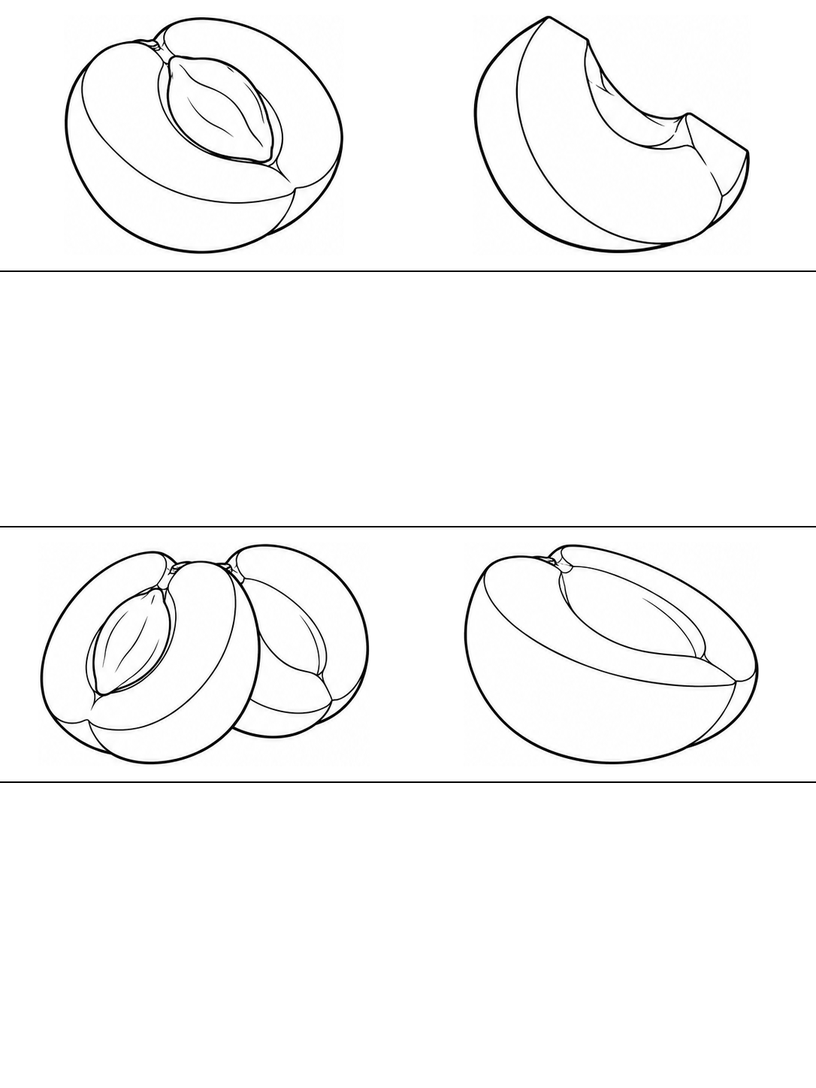
Page 4 begins with the empty-cavity half and partly peeled fruit. A thick quarter and lower-view half sit below. Choose the clearer cavity outline if the pit grooves feel busy, or trace the peel flap back to its own attachment without copying the whole fruit.
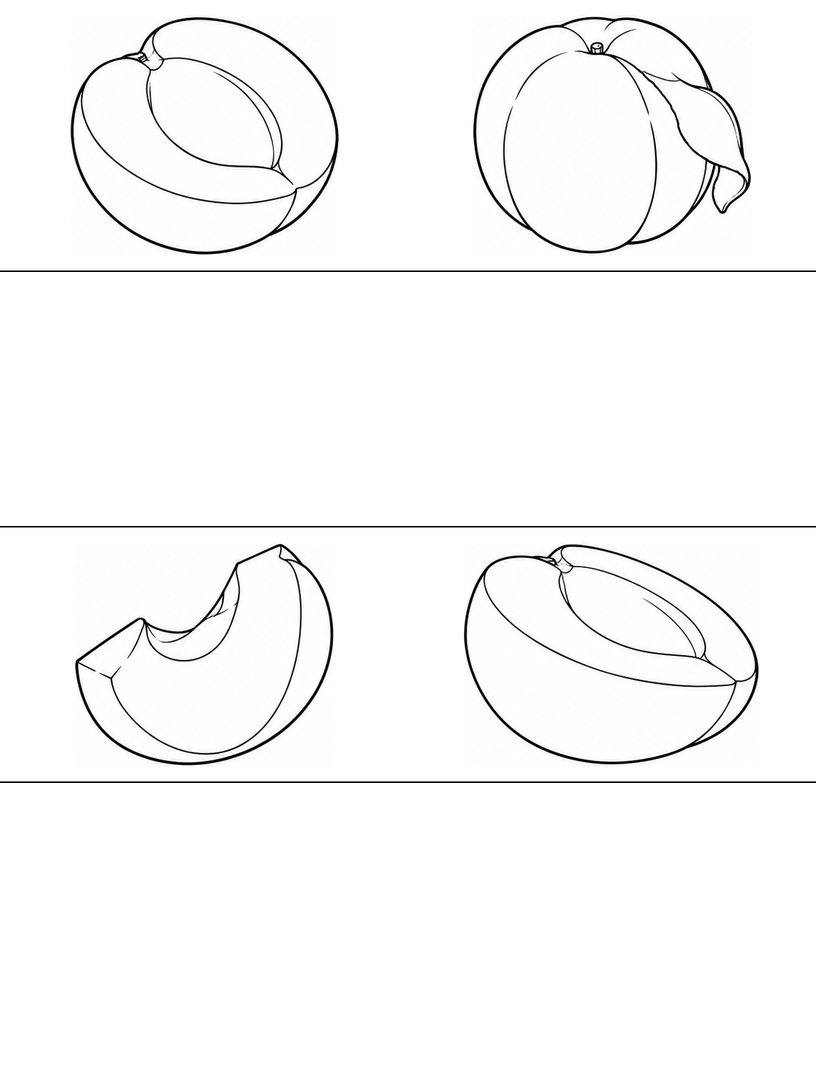
Page 5 returns to the pit half and partly peeled fruit above the complementary pair and a thick quarter. Pick one known center for another attempt. The recurring source tasks give another place to work rather than a new set of independent designs on every page.
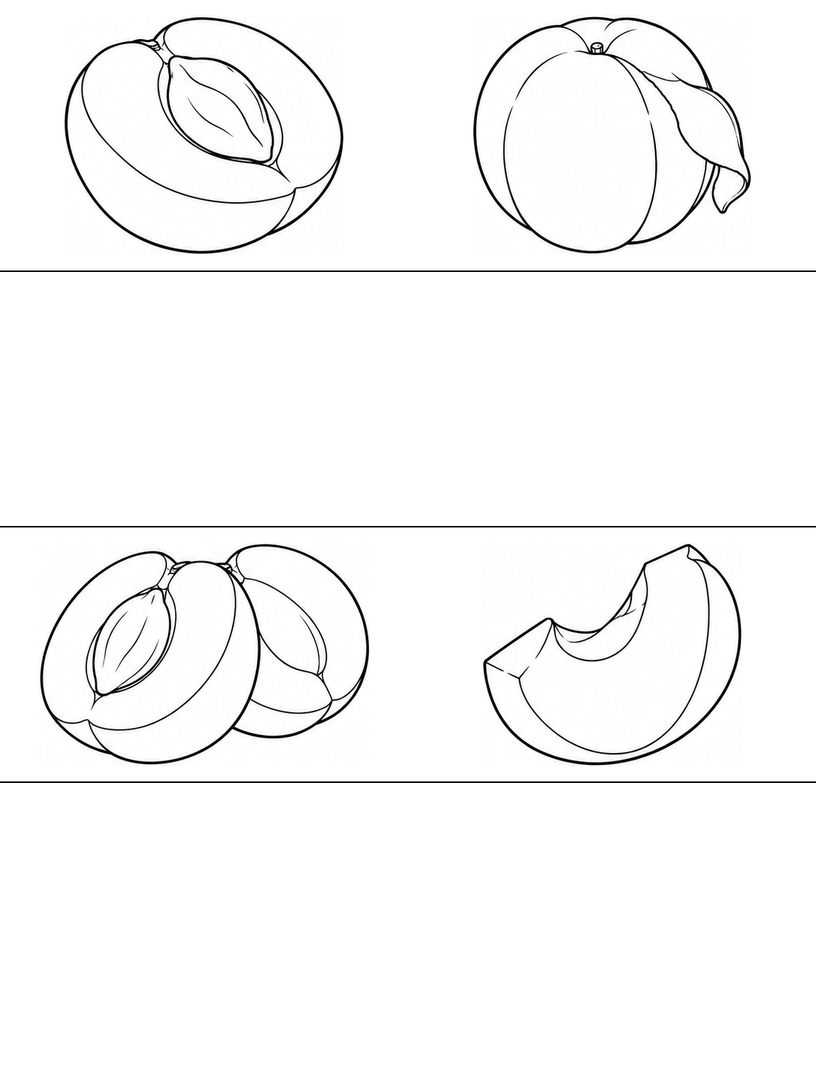
Draw a tilted peach half with room around its pit
Use the first half on page 1. Offer a blank band or spare paper and draw larger than the reference if that gives the pit and flesh more space. Follow the chosen tilt before adding any center detail.
- Set the open-face direction. Sketch a broad rounded cut-face outline leaning in the same direction as the reference. Keep a shallow dip between the upper shoulders and a gentle lower curve. The outline can be uneven; do not squeeze it into a narrow pointed heart.
- Join the curved skin wall. Add the rounded outside beneath the cut face and connect it back to the rim at both sides. Keep the open face distinct from this curved wall. Look at where each edge meets before adding a second outline or a small center.
- Place one pit inside the flesh. Draw one gently pointed oval following the direction of the cut face, with a clear flesh border around it. Add only one or two loose curved grooves if you want them. For the empty-cavity version, use the hollow outline instead and leave the pit grooves out.
If the pit reaches the cut edge on every side, make it smaller or draw the half larger in the next attempt. If it seems to float above the fruit, place it farther inside the broad face rather than beside the outer wall. If the skin wall detaches, bring its short side connections back to the rim. Your child can stop after the face and one center, leaving the grooves out and coloring a broad flesh area instead.
A made-up companion-half prompt
For an optional made-up story, imagine that a drawing of a peach half is waiting for its companion. Ask your child to find the printed half with the pit, then choose the empty-cavity outline for a drawing beside it in the blank band. They can point to the one pit and the space in the other half without drawing both pieces from scratch. The waiting story is your prompt, not a matching game or extra scene supplied inside the PDF.
Choose a simpler shape or another subject
A child who prefers coloring can leave the pit white and choose just one surrounding flesh area. A child interested in the whole fruit can follow its shallow outside seam without adding fuzzy marks. For an intact fruit with a short stem on another day, the Beginner apple sheets offer whole-fruit outlines. The Beginner bird sheets offer a change to whole cartoon birds. These are options for later, not extra tasks required today.
Printing and file notes
The PDF contains only the five Intermediate peach sheets. Choose A4 paper and 100% / Actual size, check the preview for clipped borders and try one page before printing more. Use Fit if your printer needs extra margin. The printing guide explains these settings. The files have been checked digitally, but no physical print test has been performed.
Worksheet questions
Should both complementary halves have a pit?
No. In the pictured complementary pair, one half contains the pit and the other has its empty cavity. Keep one pit total in a drawing of that pair rather than copying the same grooved center into both halves.
Do I need to add fuzz or many grooves?
No. The supplied references keep the skin and flesh open and use only a few lines on the outlined pit. Your child can omit those grooves, choose the empty-cavity half or color one broad area. Dense texture is not needed for this activity.
Are all twenty reference positions unique designs?
No. Four larger arrangements appear on each sheet, using different combinations of seven selected complete source tasks. Familiar halves, quarters and the attached peel flap recur across the five pages. Choose a view for its center or wall rather than expecting twenty unique designs.
Use and sharing
You may print these pages for personal, family or classroom activities. Keep the website credit on the sheets. Share this article link with other adults instead of redistributing or selling the PDF. Read the terms of use for the permission and its limits.
Creation and editorial note
The activity guide and page layout were prepared and edited for Coloring Pages Story, with AI assistance. The line art is AI-assisted. The page previews and five-page PDF have been checked digitally. No classroom trial or physical print test has been performed.
Comments
Comments are closed