

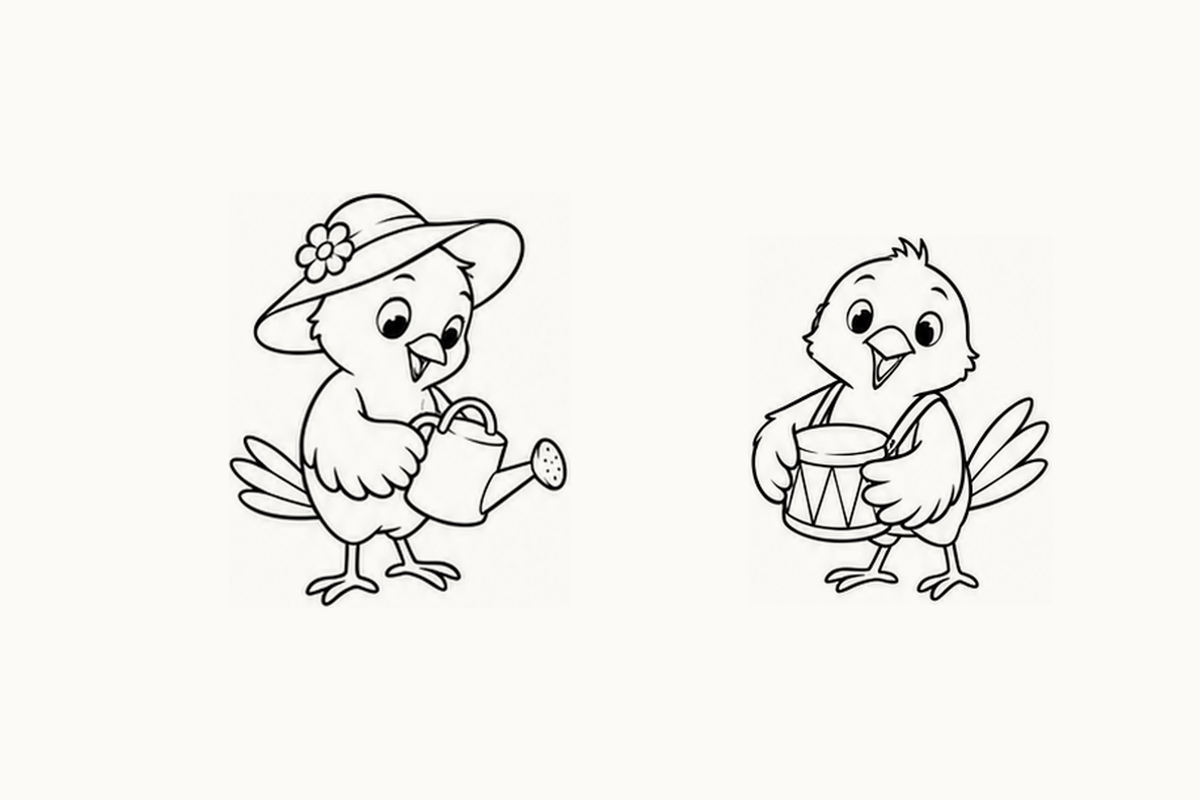
These elementary bird coloring pages offer five A4 sheets of cartoon helpers, from a bird with a watering can to a bird carrying a drum. Put out one sheet, a pencil and a few crayons. Point to the flower-hat bird in the top row of page 1 and ask, “Where does its wing meet the can?” Your child can follow that contact, color a hat or try one larger bird in an empty band. There is no need to draw every helper or fill a whole page.
Download the five-page Elementary Bird PDF (2.82 MB)
A familiar bird with something to carry
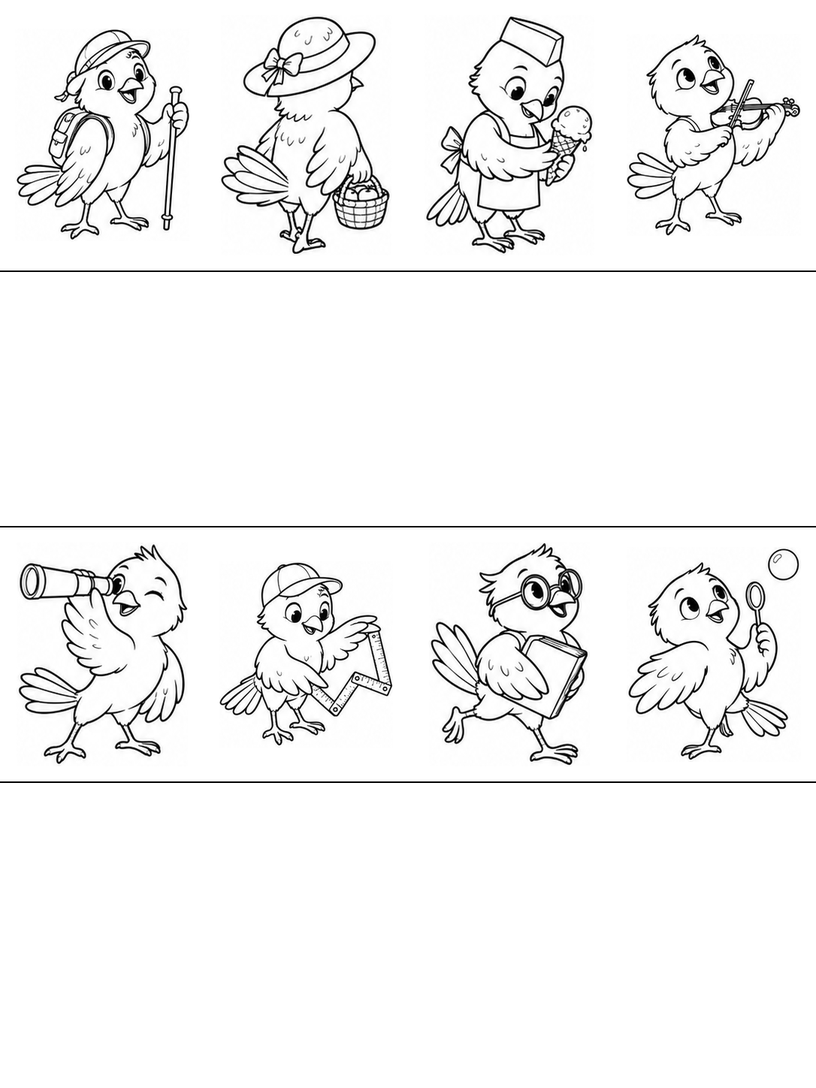
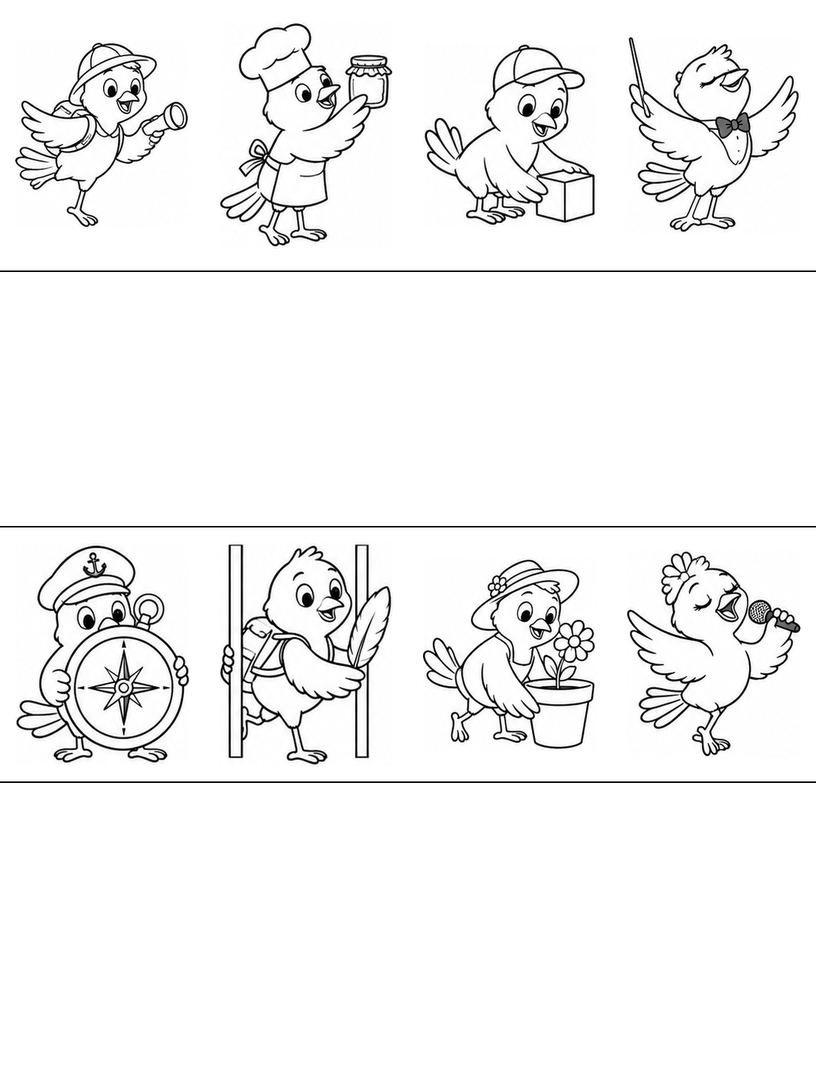
The beak, wings, feet and feathered tail remain the character's anchors. The added objects give the wings a different job: holding a chart, resting on a drum or reaching toward a tool. These are imaginary cartoon roles, not illustrations of real bird behavior. Each sheet contains eight small reference positions in two rows, with two blank practice bands. That makes forty printed positions across five sheets. The bird design, clothing ideas and drawing motifs recur; this is not a claim of forty unrelated characters or forty unique designs.
Look for the meeting point
Compare the watering-can bird with the drummer at the other end of the top row. The can sits to one side of the first bird, while the drum rests in front of the second. Find the edge where a wing covers part of an object. You can say, “Let's follow the wing back to the body.” Let your child choose the easier contact. Coloring only the can or the drum is a useful first turn, and a made-up color is welcome.
See all five complete sheets
Page 1 also shows a scout with a cloth bag, a cook with a rolling pin, a sailor holding a paper boat and a bird carrying a star chart. In the lower row, the letter carrier lifts a foot above a low rail. Choose one connection to notice: wing to bag, wing to handle or foot over rail. You do not have to name every role.
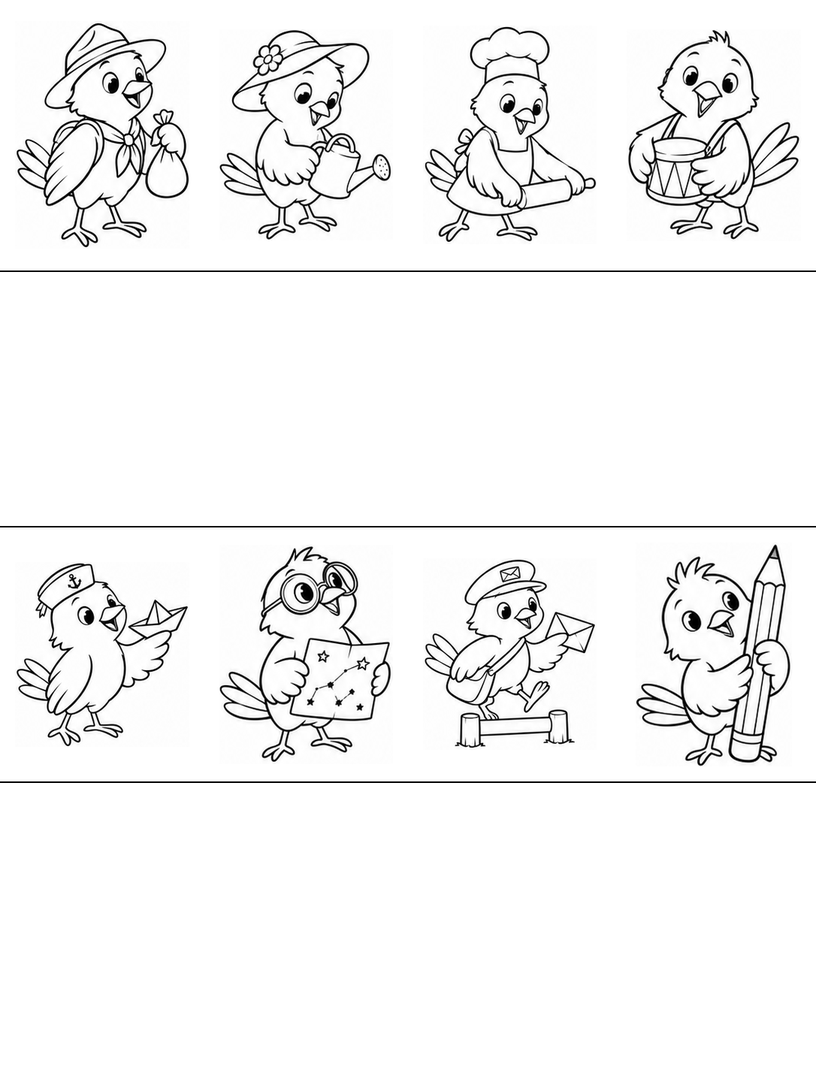
On page 2, a bird lifts a leaf beside a bag, another holds a fruit basket and a small repairer sits behind a wheeled toy. Below them, a bird carries an open book along a sloping line. If the basket or book hides part of a wing, point to the visible part and trace its direction in the air rather than adding a line through the object.
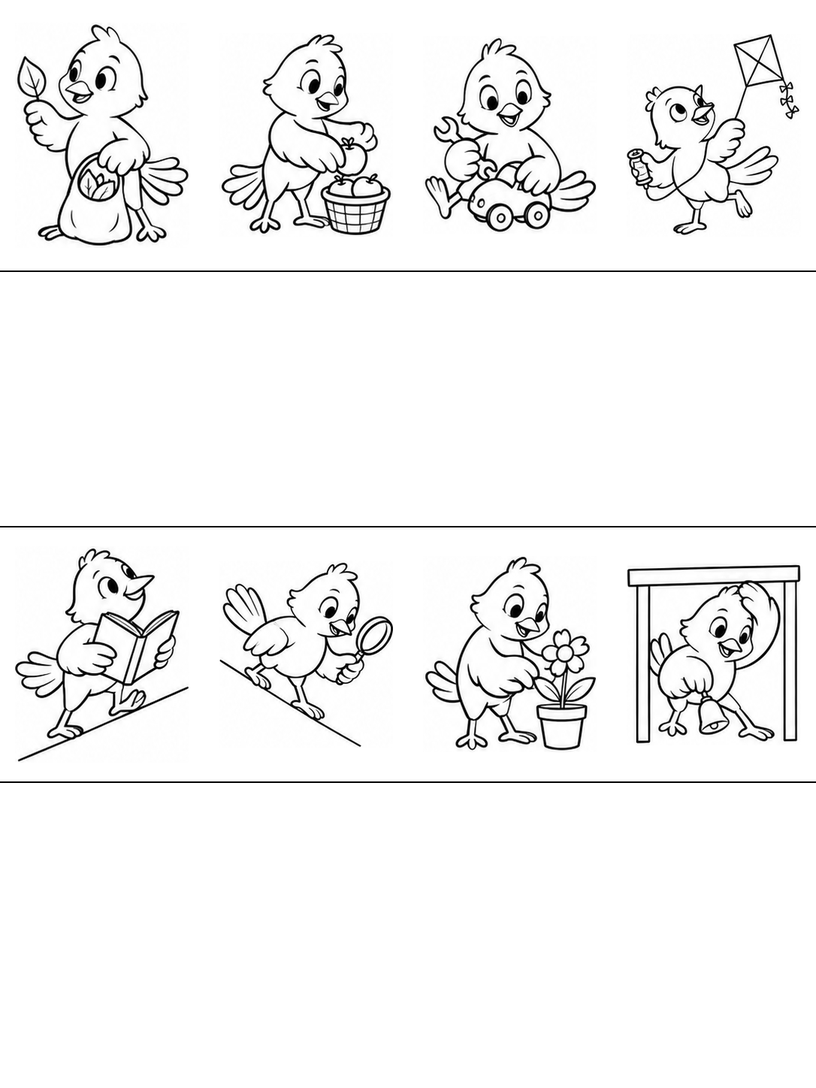
Page 3 gives the birds a flashlight, a trowel, a bread tray and other small objects. The dancer in the top row holds a long curved ribbon. Follow that curve with a finger before choosing a color. Your child's own bird can hold a short line instead of a detailed tool; the important part of this drawing turn is that the line reaches its wing.
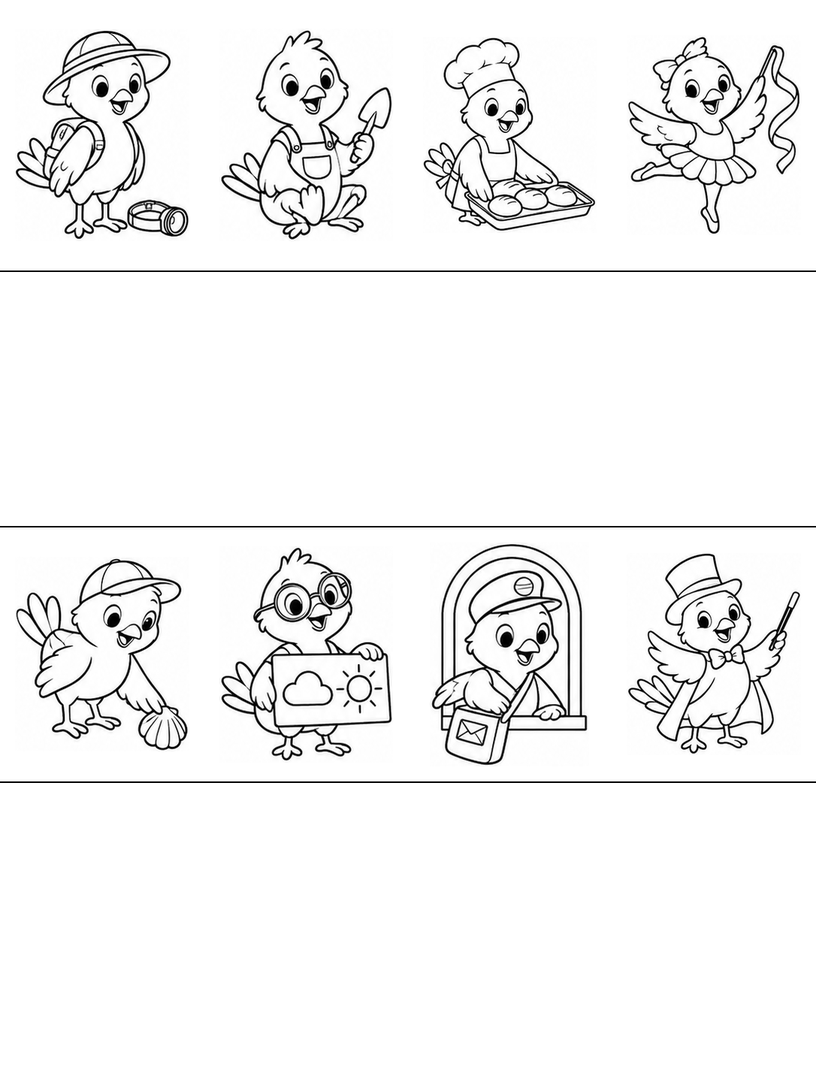
On page 4, compare the back-facing basket carrier with the birds facing toward us. Its face is not repeated on the back of its head. The violin, telescope and folding ruler offer longer shapes to follow, but none needs to appear in your child's drawing. A short staff beside one bird is enough if the smaller details feel crowded.
Page 5 includes a bird reaching toward a jar, a crouching block helper and a bird standing beside a large compass. The lower-row gardener carries a flowerpot. You might return to that bird after trying the watering-can drawing: both use a rounded container, but the contact between wing and object is in a different place. Stop after that comparison if your child has had enough.
Draw a cartoon bird beside a watering can
Use the flower-hat bird on page 1 as a reference, but leave out the hat at first. Work in a blank band or on spare paper. A drawing larger than the printed example leaves room for the can and the short wing that meets it.
- Place the bird and the can. Draw a rounded head above a larger body oval. Add a short beak on the side facing the can. Beside the body, sketch a small rounded container with space above it for a curved handle. Keep the can close enough for a wing to reach it.
- Connect one wing to the handle. Start the wing on the side of the body and curve it toward the top of the can. Let the wing edge cover a short part of the handle instead of drawing both lines through each other. Add a short spout that grows from the other side of the container.
- Give the bird a place to stand. Draw two short legs below the body and spread a few simple toes beneath them. Add a small fan of tail feathers behind the body. Choose whether to add the second wing, an eye or a hat, then color any open shape you like.
If the wing seems to float between the bird and the can, bring its starting curve back to the body before adding more feather lines. If the can hides the entire bird, make the container smaller on a new attempt or draw the bird larger. If the handle is fiddly, omit it and let the wing touch the can's top edge. Ask, “Would you like a handle, or shall the wing rest here?” Both choices keep the contact clear without tracing over the same crowded spot.
An optional made-up garden errand
Make up a small story: a cartoon bird is bringing water to a pretend garden, but has room for only one pot. Ask your child to find a flowerpot on page 2 or page 5, then draw their own pot beside their bird in a blank band. Let them choose what might grow there. The errand is your story prompt; the PDF contains the separate reference drawings, not a finished garden scene.
Choose a simpler outline or a different object
If the prop makes the drawing busy, the Beginner bird sheets offer whole cartoon birds without these helper objects. For a different kind of outline, try the Beginner apple sheets. Your child can also stay with one favorite bird and change only the color of its hat. Another new drawing is optional.
Printing and file notes
The download contains only the five Elementary bird sheets, not every level in the source workbook. Choose A4 paper and 100% / Actual size in your PDF reader. Check the preview for missing borders, then try one page before printing the rest. Use Fit if your printer needs more margin. The printing guide explains these choices. These files have been checked digitally; no physical print test has been performed, and the result on your printer has not been verified.
Worksheet questions
Are the helpers pictures of real birds using tools?
No. They are imaginary cartoon birds with beaks, wings and feathered tails. Their outfits and object-holding gestures support a drawing activity; they are not examples of natural bird behavior or particular bird species.
Do I need to copy every object on the sheet?
No. Choose one bird and one contact, such as a wing meeting a can. Leave out a hat, badge or small tool if it makes the drawing easier to follow. Coloring one shape or pointing to a connection is enough for one turn.
Does this download include all four bird levels?
No. It contains only the five Elementary sheets. Each has eight small reference positions and two empty practice bands. Other levels are separate articles and downloads; this set does not include the entire multi-level source workbook.
Use and sharing
You may print these pages for personal, family or classroom activities. Keep the website credit on the sheets. Share this article link with other adults instead of redistributing or selling the PDF. Read the terms of use for the permission and its limits.
Creation and editorial note
The activity guide and page layout were prepared and edited for Coloring Pages Story, with AI assistance. The line art is AI-assisted. The page previews and five-page PDF have been checked digitally. No classroom trial or physical print test has been performed.
Comments
Comments are closed