

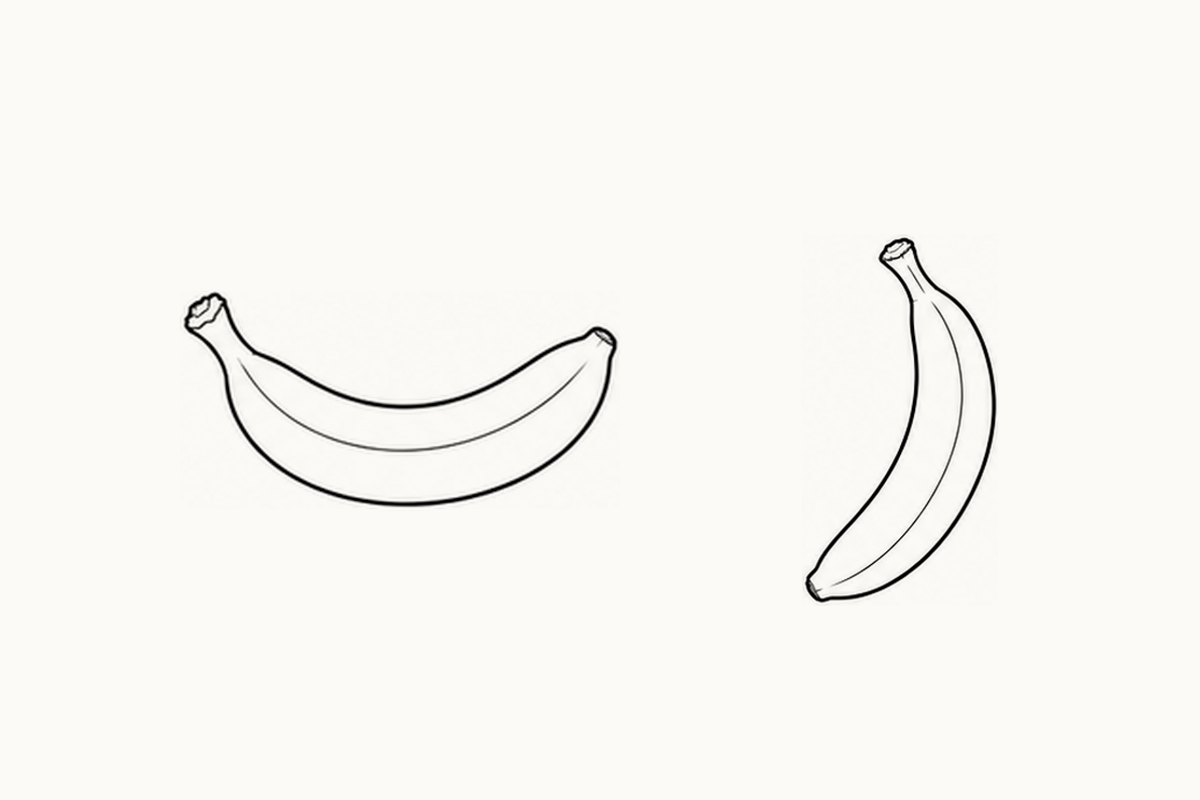
These beginner banana coloring pages contain five A4 sheets of whole, unpeeled fruit in different directions, with blank bands for drawing. Put out a pencil, a few crayons and one sheet. Point to the horizontal banana at the top left of page 1 and ask, “Which edge makes a shallow bowl shape?” Your child can follow that inward bend, color the fruit or draw a larger banana below it. Begin with one outline; the other references can wait for another turn.
Download the five-page Beginner Banana PDF (1.22 MB)
What is in this set?
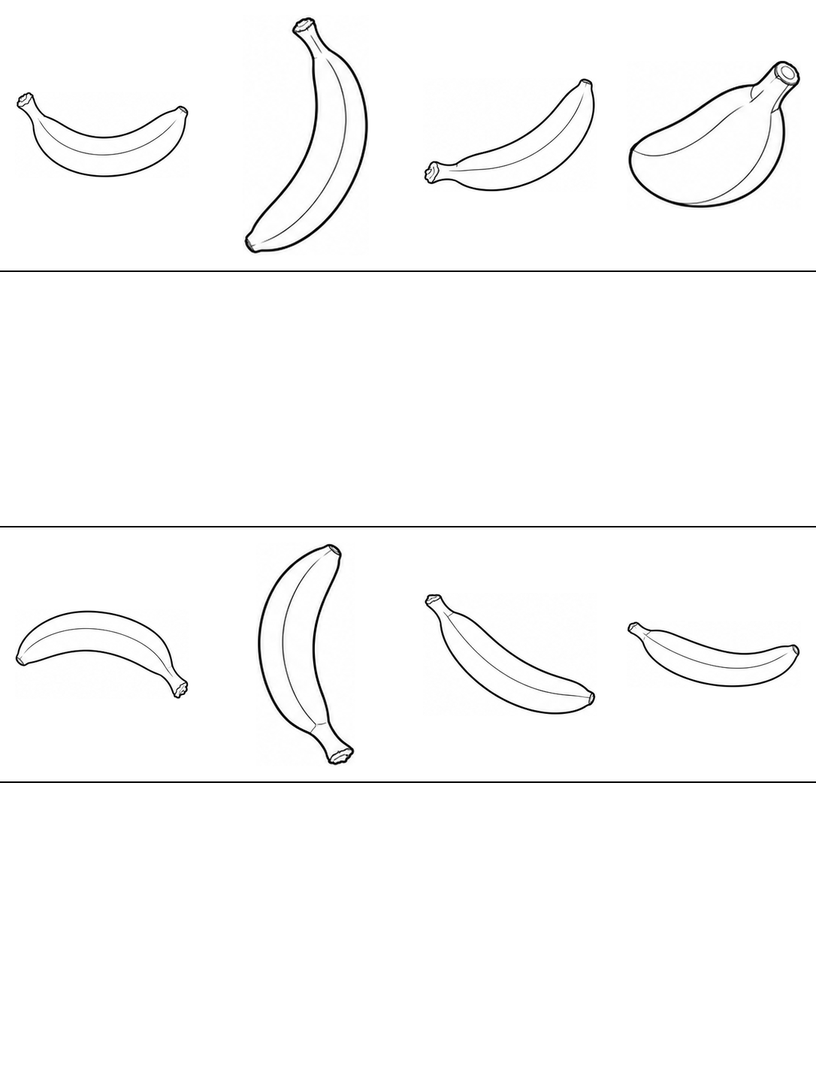
Each page has eight small whole-banana references in two rows and two empty practice bands. The five sheets reuse fifteen selected source drawings in different combinations; forty printed positions are not forty unique designs. Some fruits lie horizontally, others stand upright or slope across the page. Their stalks point in different directions, and light inner contours follow the curved body. There are no open peel flaps, loose slices, faces or added objects in these Beginner pictures.
Find the stalk, then follow the bend
Look at the first two references across the top of page 1. One banana lies across the page, while the next stands tall. Ask your child to point to the short stalk on each. Starting from that stalk, follow one long edge toward the other end and then return along the opposite edge. One side bends inward and the other swells outward. Let your child choose a view that feels comfortable to follow, or turn the sheet so the chosen fruit lies across the space in front of them.
See the five complete pages
Page 1 begins with a shallow, upward-curving banana whose stalk is on the left, followed by an upright fruit. Look at the small, short-looking fruit at the far right of the top row too. Its narrow projecting stalk has a hollow end contour; this is not a large open cut through the banana flesh.
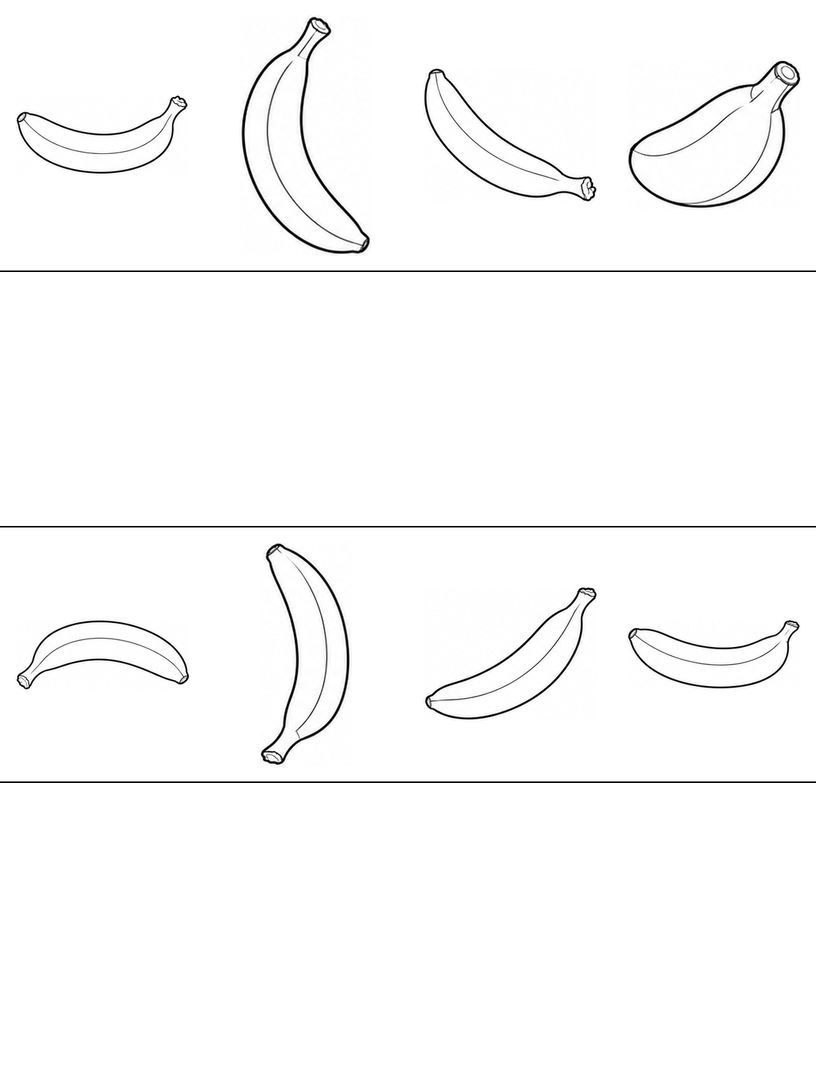
Page 2 changes several directions, including a horizontal view with its stalk on the right. Compare that with the first page before drawing. A child who notices only the stalk has already found a useful starting point; there is no need to name every direction on the sheet.
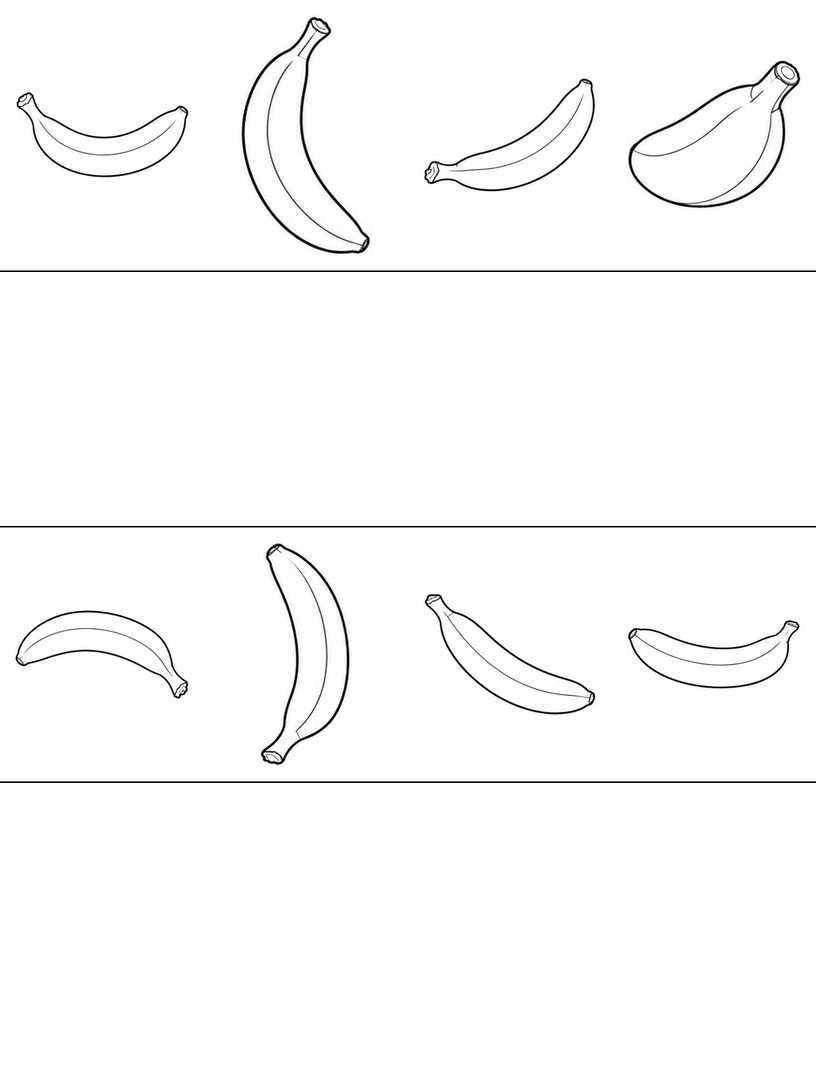
Page 3 recombines familiar horizontal, upright and diagonal outlines. Choose two whose ends turn differently. You can hold a finger above each pointed fruit end while your child follows the broad curved body, keeping that end separate from the short stalk.
Page 4 brings long upright fruits and sloping views together again. If a tall shape is awkward to fit into a practice band, rotate the paper or draw a smaller version on spare paper. Keep enough room at both ends before beginning the long curves.
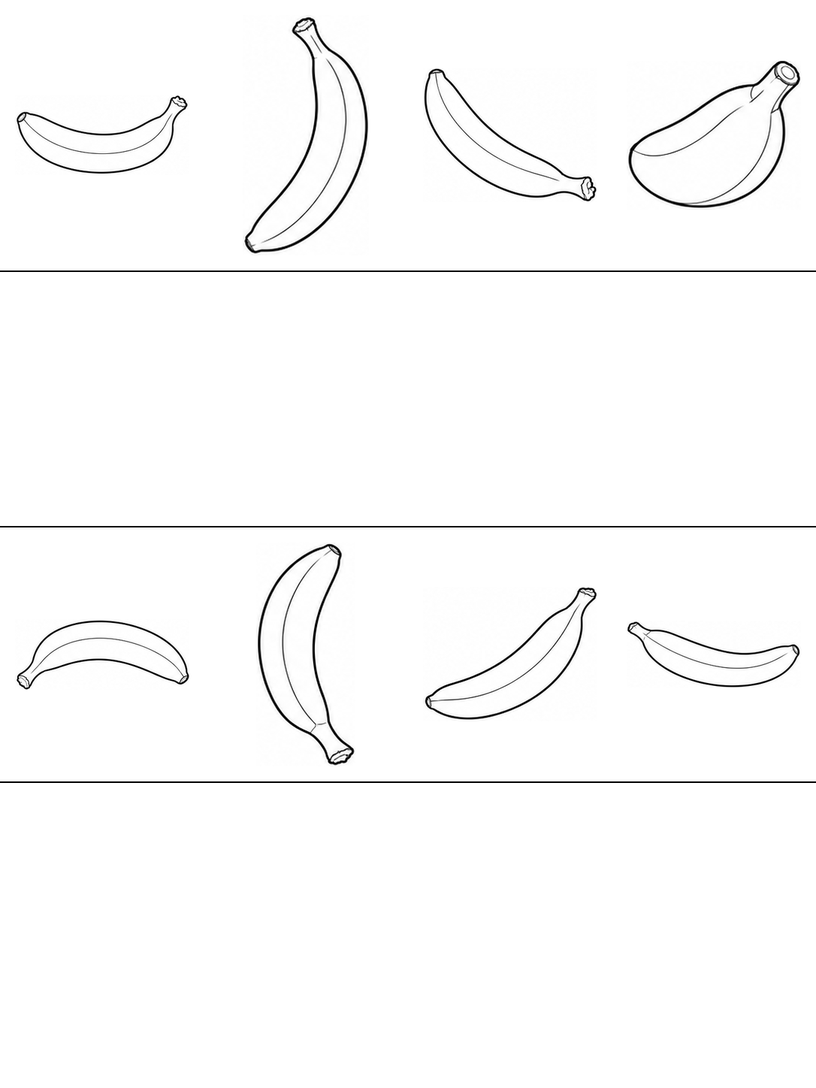
Page 5 offers another arrangement of known upward, downward and diagonal curves. Return to one your child recognizes, then change its size in a blank band. Repetition is part of the set; they do not need to treat each reference as a new drawing task.
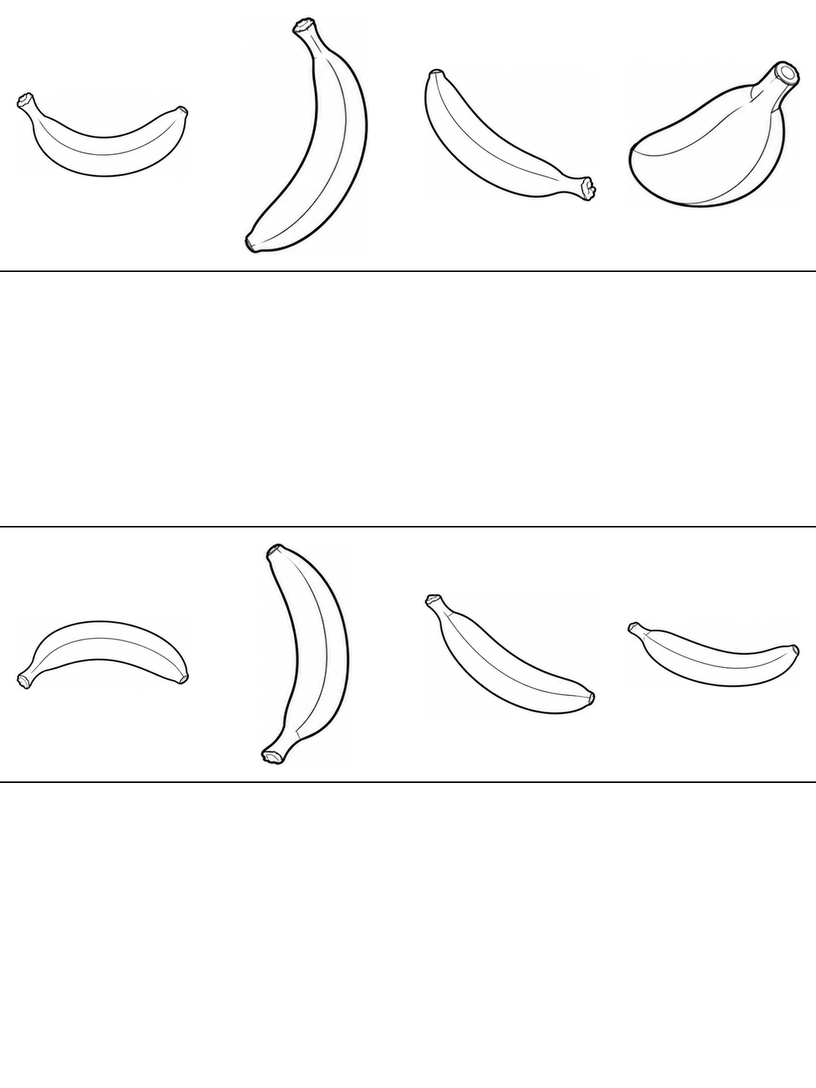
Draw a whole banana with two connected curves
Use the top-left reference on page 1. Offer a blank band or a separate sheet and leave room for a short stalk on the left. Drawing larger than the reference can make the space between the two edges easier to manage.
- Mark the ends and the inward bend. Place two light dots where the fruit will begin and end. Between them, draw a shallow curved line that dips like a small bowl. It does not need to be perfectly smooth or equally high at both ends.
- Bring the outside curve around. Starting near one end, draw a fuller curve underneath the first line. Let the gap between the two lines grow through the broad middle, then narrow gradually as it reaches the other end. Join the lines at the blunt fruit tip.
- Attach the short stalk. At the remaining end, bring the outline into a short, narrow stalk and join its two edges. Add one light inner curve along the fruit only if you want it. Keep that line following the same bend instead of turning it into a set of straight stripes.
If the drawing looks like a very thin crescent, let the next outside curve bow farther away from the inward edge. If it looks like a straight tube, return to the reference and notice how both ends turn upward around the dip. If the stalk floats away from the body, connect its lower edges to the fruit. Choose just one change for a second attempt, or stop with the broad outside shape and color that instead.
An optional made-up fruit-basket choice
Here is a made-up story prompt: a fruit basket has one curved space left, and your child chooses which banana to place there. Ask them to find a view on the sheet, then draw their own banana in a blank band. They may add a basket around their drawing if they want. The basket is their addition; the PDF contains the whole-fruit references and empty bands, not a printed basket scene.
Choose a color or another outline
Offer two crayons and let your child pick a color for one fruit. Yellow is one option, but their drawing can use another color or stay as an outline. For a rounder fruit shape on another day, the Beginner apple sheets compare whole apples and their short stems. If a different subject is more appealing, the Beginner bird sheets offer whole cartoon birds with blank bands. Neither is an extra task required to finish this activity.
Printing and file notes
The download contains only the five Beginner banana sheets. Choose A4 paper and 100% / Actual size in your PDF reader. Check the preview for clipped borders and try one page before printing the rest. Use Fit if your printer needs more margin. The printing guide explains these settings. The file has been checked digitally, but no physical print test has been performed.
Worksheet questions
Are all forty bananas different drawings?
No. The eight positions on each sheet use different combinations of fifteen selected source drawings. Familiar curved outlines recur across the five pages. Choose a page for a view you want rather than expecting forty unique designs.
Does the little oval on the short stalk show banana flesh?
No. In the short-looking oblique reference, that small hollow contour belongs to the end of the narrow projecting stalk. These Beginner pages show whole unpeeled fruit, not open flesh sections or loose cut pieces.
Do I need to copy every inner line?
No. Start with two connected outer curves and a stalk. Your child can leave out the inner contour, draw a larger fruit or color one printed reference. An outline with different sides still gives you a whole banana to work with.
Use and sharing
You may print these pages for personal, family or classroom activities. Keep the website credit on the sheets. Share this article link with other adults instead of redistributing or selling the PDF. Read the terms of use for the permission and its limits.
Creation and editorial note
The activity guide and page layout were prepared and edited for Coloring Pages Story, with AI assistance. The line art is AI-assisted. The page previews and five-page PDF have been checked digitally. No classroom trial or physical print test has been performed.
Comments
Comments are closed