

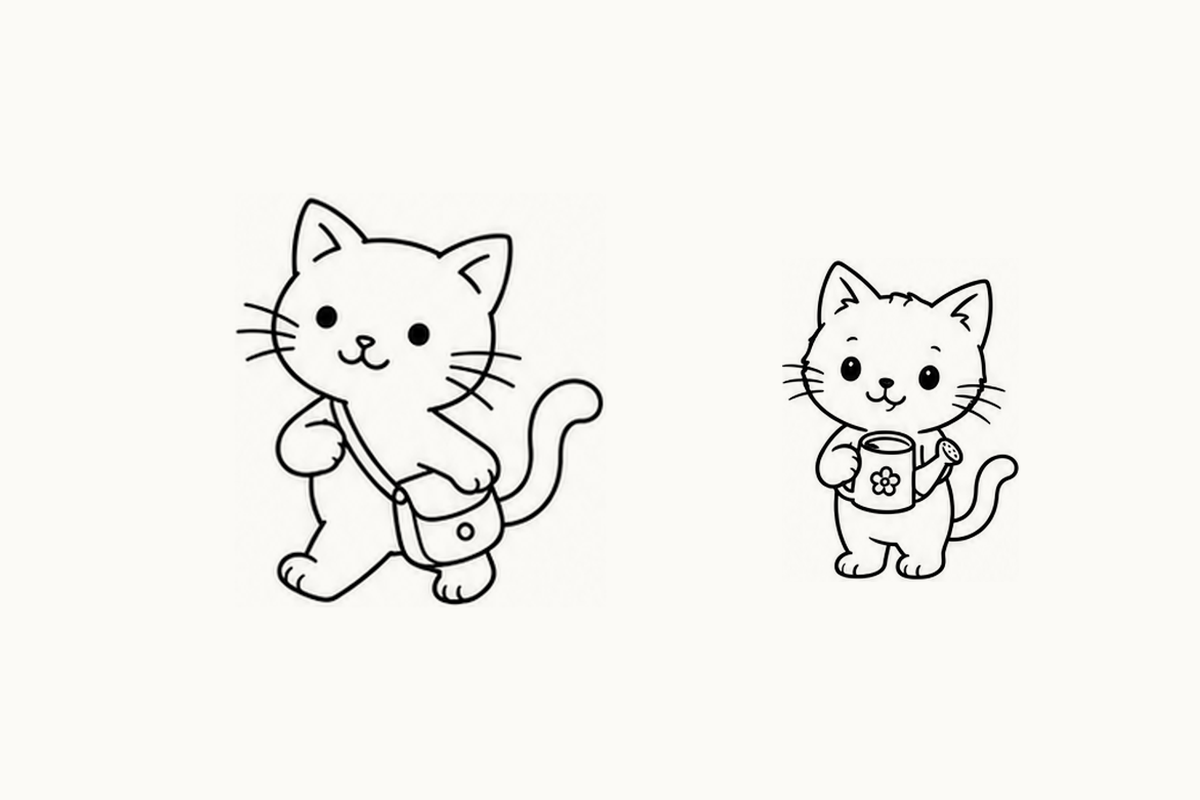
A cat is holding a watering can, and another is ready with a paintbrush. Before choosing colors, look at the place where a paw meets an object. These elementary cat coloring pages include five A4 sheets of playful cartoon scenes and blank drawing bands. One handle, one book edge or one curved tail can be enough to start. Your child can leave the rest for another day.
Download the five-page Elementary Cartoon Cat PDF (2.58 MB)
What is in this set?
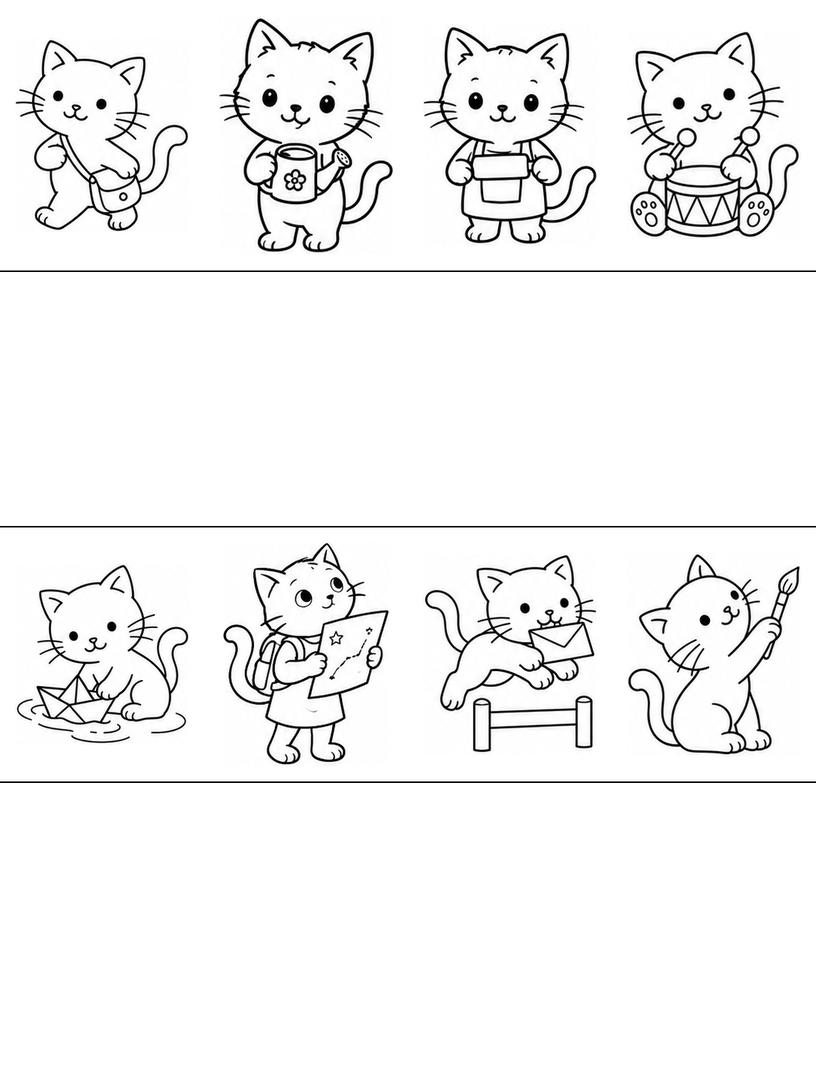
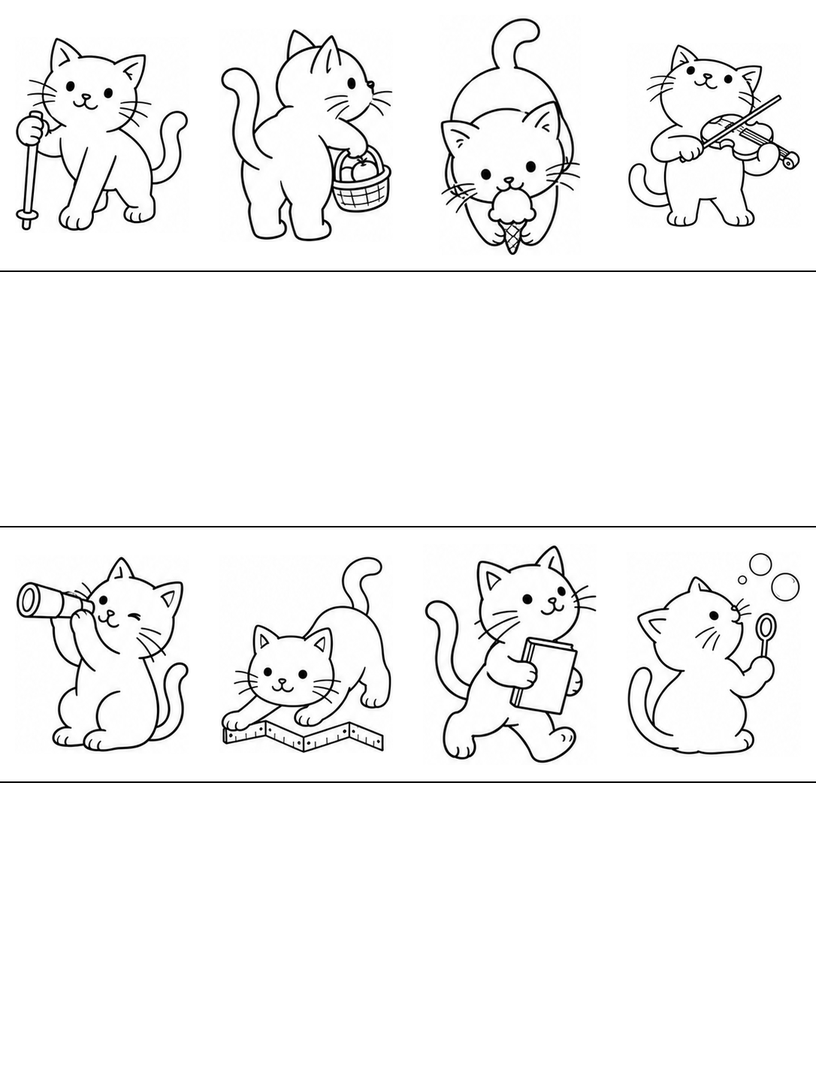
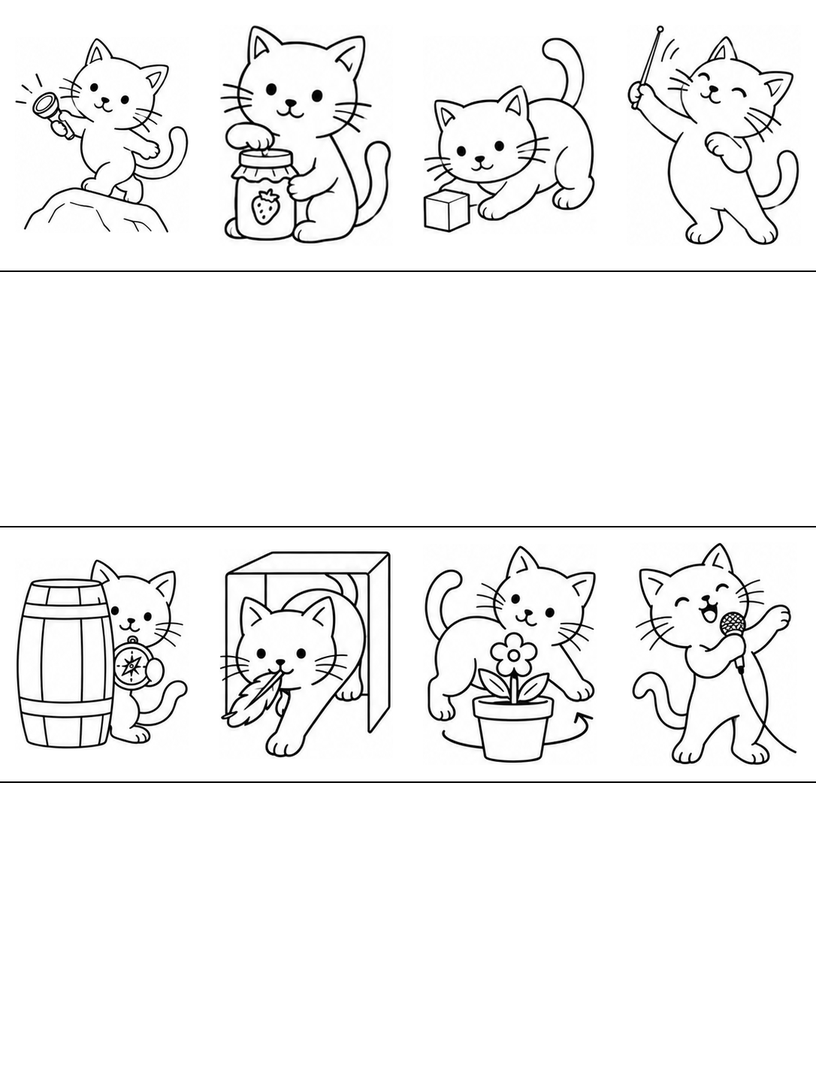
Each sheet has eight references, four in the first band and four in the third, with blank practice space underneath. The cats use imagined human-like props and gestures: books, tools, instruments and bags appear among the scenes. This is fantasy character drawing, not real feline behavior. Some face and body shapes recur. The set contains five Elementary layouts, not a whole four-level workbook or forty guaranteed unique characters.
Before you begin
Find the watering can near the top of page 1. Compare its round opening with the long spout. Then ask your child to find the paw closest to the handle. If that small area is hard to color, leave it white and color the can's larger body. A useful picture can keep some narrow spaces unfilled.
Look through the five sheets
Page 1 includes a shoulder bag, watering can, apron, drum, paper boat, map, envelope and paintbrush. Choose a large object shape to draw first. For the open paper boat, look at the folded triangles before adding the cat behind it or the water marks below.
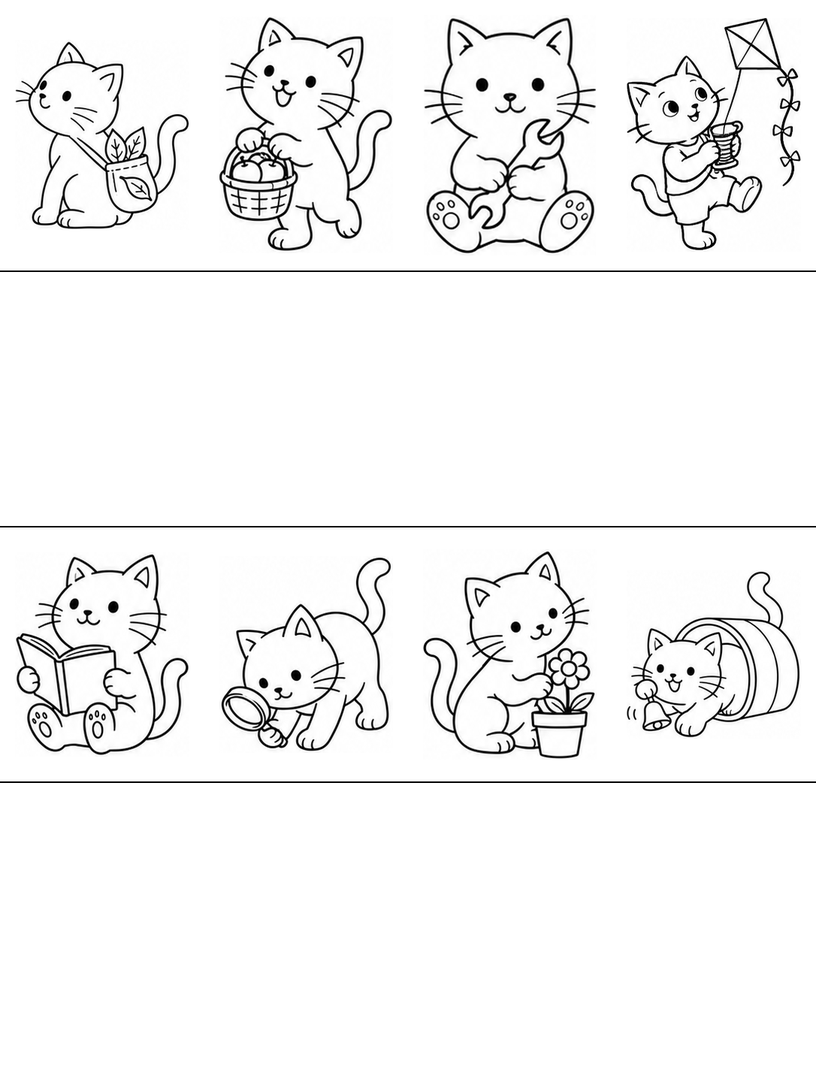
Page 2 includes a basket, wrench, kite, book, magnifying glass, flowerpot and a cat emerging from a tunnel. Compare the book's straight edges with the basket's curved rim. Your child can draw one of those object shapes alone before deciding where its cat should sit.
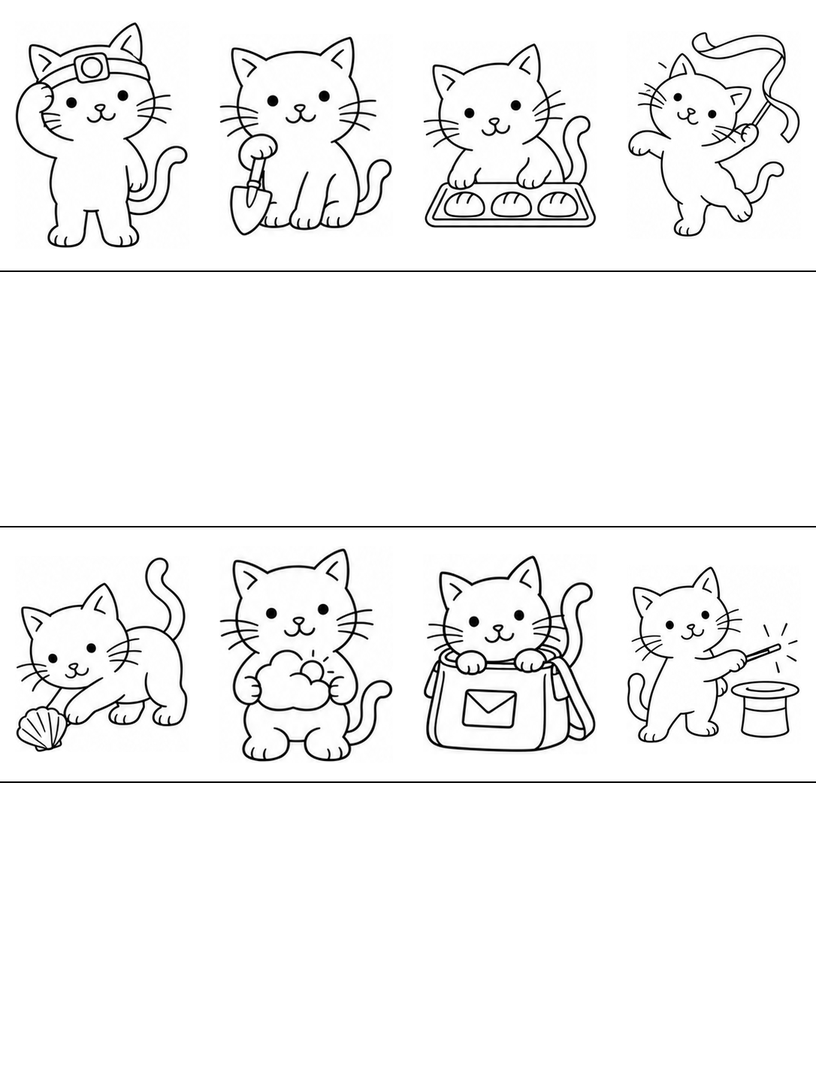
Page 3 includes a headlamp, small shovel, bread tray, ribbon, shell, cloud shape, satchel and wand. Try following a ribbon's long curve in the air. When drawing, leave space around the cat's head and tail so the ribbon does not accidentally hide their outlines.
Page 4 pairs familiar prop scenes with a violin, telescope, folding ruler, book and bubble wand. Look at the violin's large body before the strings. You can color the object and the cat differently to make their meeting point easier to read.
Page 5 includes a flashlight, jar, block, conductor's baton, compass, table opening, potted flower and microphone. The table scene gives a clear front-and-back question. Find which edge hides part of the cat before trying a simple cat head behind a rectangle below.
Draw a cartoon cat holding a watering can
Use page 1 as your reference, but keep the first drawing simple. A larger rehearsal on spare paper gives the handle and paws more room. You can leave out the flower mark on the can until the main connection is clear.
- Give the cat and can their own space. Sketch a rounded head and a small standing body, leaving room beside the chest for the can. Add the can's broad body and a short spout. Check that the can does not cover the face before drawing the paws or any tiny decoration.
- Make the handle and paw meet. Draw a curved handle with an opening inside it. Bring one simple cartoon paw to the handle and another toward the can body, following the reference. Stop the back edge of the object where the front paw covers it. Do not add extra fingers to solve a crowded connection.
- Finish the readable shapes first. Connect the cat's tail at the rump and add a simple face. Keep the spout open and the handle opening visible. Then choose whether to add the can's flower mark. Look once more at the paw-to-handle join before filling the large areas with color.
If a paw seems to float near the can, compare the small gap at the contact point. A short curve may join them. If the handle has become a dark knot, draw a larger can by itself on spare paper and try again. You do not need to redraw all eight characters to practice that one connection.
A small delivery day
Make up a delivery day. A cat carries a message to a friend and pauses beside a potted flower. Choose an envelope scene and a flower scene from the sheets. Draw one small message shape in the blank band, then tell each other who might receive it. A circle or zigzag can stand for the message; writing is optional. Will the cat put it on a table or hold it out? Compare where a paw would cover the envelope's edge in those two choices.
Make the activity your own
For a gentler turn, color the cat and its prop in two clear colors without drawing. For another attempt, use a plain rectangle as a book and place two paws partly in front of it. Compare which line must stop. Changing one contact is a more focused challenge than adding extra tools, costume details or complicated scenery.
If the prop crowds the drawing, the Beginner cat guide returns to a plain seated body, attached ears, paws and one connected tail. After a paw-to-handle join, the Intermediate box-overlap activity offers a different overlap: a paw in front of a box while the body stays partly hidden behind it.
Printing and file notes
Select one of the five Elementary A4 sheets in your PDF reader's page range. Start with 100% / Actual size, look for cut edges in the print preview, and try one page. Use Fit if your printer needs more margin. For paper size and print settings, read the printing guide.
Worksheet questions
Do these pages show things real cats do?
No. The tool use, music and other human-like activities are fantasy cartoon scenes. The drawing practice is about visible shapes, contact and overlap. It should not be used as a real-animal behavior or care guide.
What is included in the Elementary download?
Only five A4 Elementary sheets are included. Each has eight small scene references and two blank practice bands. Some character shapes and ideas recur. The previews show the actual layouts, rather than full-page cat portraits or every difficulty level.
What if small handles and tools are hard to color?
Leave narrow gaps white or draw a larger object on spare paper. Print one sheet first using A4 and 100% / Actual size, checking for clipping. Try Fit if your printer needs extra margins.
Use and sharing
You may print these pages for personal, family or classroom activities. Keep the website credit on the sheets. Share this article link with other adults instead of redistributing or selling the PDF. Read the terms of use for the permission and its limits.
Creation and editorial note
The activity guide and page layout were prepared and edited for Coloring Pages Story, with AI assistance. The line art is AI-assisted. The page previews and five-page PDF have been checked digitally. No classroom trial or physical print test has been performed.
Comments
Comments are closed